Monday, September 24, 2007
A post accomplishment slump
Saturday, September 22, 2007
Saturday Stuff
I went to Joshua's high school's open house, along with all the other parents of freshmen, and I came away thinking what a not-so-good high school I went to. Joshua will be reading Cicero in the original Latin by next year. He'll be reading lots of serious novels. He'll be doing experiments looking at DNA using some fancy gene separator. I'm pretty sure it took my high school biology class about a semester to cut up a couple of frogs.
The logical progression of current standards of beauty... creepy.
Some interesting advice on blogging.
Friday, September 21, 2007
State religions in the world

Thursday, September 20, 2007
Humanities vs. social sciences
For those in the business, do you think sociology is all social science or part humanities too? I have my ideas, but they are not grounded in very systematic observation (said like a social scientist, I suppose).
Wednesday, September 19, 2007
How parents respond to kid's religious doubts
Here's a video clip that illustrates this process to somewhat of an extreme. (Course language). Now, most parents would be more dignified in their responses, but I would imagine many would use a similar approach of attempted power & complete lack of empathy...
Tuesday, September 18, 2007
Who is your professor?
This makes it a good time to reflect on just who your professors are. One answer is that professors are different from you in various ways, and these differences affect the education that you get.
First off, we’re old(er). Graduate school usually takes five to eight years, and many of us take time off before graduate school (some I heartily recommend, by the way). As such, most professors start in their thirties—almost double the age of entering freshmen. Furthermore, being a professor is a *great* job and not physically demanding--chalk isn’t really that heavy, so we tend to stay with the job until we’re pretty old. This is especially true for those of us who aren’t particularly good at saving money, since we probably won’t afford to retire.
What does our “old” age mean for students? Professors come from a different generation, and each generation has its own values and way of looking at things. The oldest generation still teaching in large numbers is the baby boomers—part of the population explosion after World War II who went through the crazy days of the 1960s. They started off as radical Because of these generational differences, professors and students share different cultural references and ways of communicating. We professors are constantly referring to things that students either don’t know about or don’t care about. Students practically have to translate what professors are saying as if it were in a different language. This is especially true in the humanities and social sciences, including sociology, which centers on social and cultural analysis.
Second, we professor types tend to be liberal. In the general population, there are moderately more liberals than there are conservatives. By some counts, the Democratic Party has between a third to a half more members than the Republican Party does. As a group professors are overwhelmingly liberal compared with the general population. For every one professor who self-identifies as a conservative, eight are liberal. This imbalance is even more pronounced in the social sciences, where every conservative is matched by an estimated fourteen liberals. Many, and perhaps most, sociology students will never have a sociology professor who has conservative views.
What are the implications of this difference? If you listen to us, we’ll probably make you more liberal. In fact, some professors (especially in sociology) see this as part of their teaching mission. Others try hard to be neutral in our presentation of ideas, but it’s hard to imagine that our own beliefs remain completely hidden—no matter how hard we may try.
Is this good or bad? It probably depends on your political perspective: You’d probably like it if you’re liberal and dislike it if you’re conservative. The important thing, though, is to be aware of the political assumptions, and the possible resulting biases, of your professors.
Third, we’re much less religious than the general population of students we teach. A recent study of American professors found that they affiliate with religion less often than the general population. This is especially true at the top universities where 37% percent of professors are agnostic or atheists compared to only 7% in the general population. Likewise, only about 1% of professors in top universities identify themselves as “born-again,” compared to a full 33% of the general population.
This means that students receive a distinctive treatment of religion in the classroom. Just as professors make their students more liberal, they also tend to make them less religious. Religious students who take sociology may have a particularly difficult time since in this discipline religion is often presented as wrong, irrelevant, or harmful.
Fourth, we’re not always intelligent. How smart are professors? Usually pretty smart, but not always. Another recent study compared the average intelligence of professors to those in other careers, and university professors scored at about the highest level (along with doctors), which I suppose is good news if we’re going to be teaching people. There was, however, a wide range of intelligence among professors, with more than few at intelligence levels that were average of society as a whole.
What do these four differences mean for our students? Students should realize that we have our own experiences, beliefs, and biases, and that we’re not always the sharpest knife in the drawer. The next time that you listen to a professor talk (and talk and talk), take the time to critically evaluate what they say. Just as professors frequently ask questions to students, students should question their professors.
Source
Monday, September 17, 2007
Happy Birthday John!

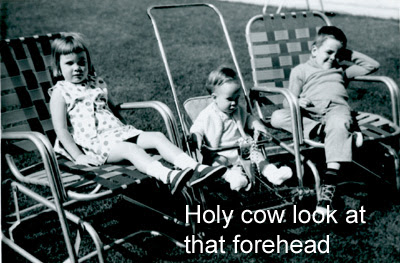
Here's a picture of him (between me and my sister Susan) when we lived in Ecuador (where John was born). I got the picture from John's website, and he added the comment about the forehead. I don't say anything because those of us in glass houses...
A funny thing about this picture, is that I still sit that way whenever possible. I found myself doing that during office hours while talking to a student, and I straightened up in a futile attempt to look professional. (Wearing shoes would have helped too).
Happy Birthday John!
Saturday, September 15, 2007
Saturday stuff

The secret behind some sociological theories.
Is blogging now a constitutional right? Cool. Life, liberty, and the freedom to ramble. (Thanks David for the link)
This is irony.
Friday, September 14, 2007
College and faith
In Mark's words, "Surprisingly enough though, college graduates reported a 59.2-percent decline in religious service attendance compared to a 76.2-percent decline among those who chose not to attend college, according to the report. Regnerus and Uecker explain that the structure of college life reinforces and provides for a more religion-friendly environment. Through student organizations and various network associations, college students live in an atmosphere that allows them to maintain their religious beliefs."
This certainly flies in the face of common wisdom about sending your Christian child to college. I think that in the past, parents, pastors, and others have noticed that lots of college kids drift away from organized religion and concluded that college had that effect. Now it seems that it's a function of their age, not educational setting, and those who don't go to college do even worse.
Thursday, September 13, 2007
Gender and old age
This has got me thinking about old age and how it varies by gender. It seems to me that women live longer than men in part because they maintain their social roles longer into old age. Here's what I mean...
A traditional perspective on men has them working hard outside the home and coming home and having much less to do. Take away the work, e.g., retirement, and the man doesn't do much. Not doing much = accelerated decline in well being.
A traditional view of women, on the other hand, have them engaged in family and social connections that one doesn't suddenly retire from. Ergo, they are more involved during the retirement years and they do better.
These thoughts are informed by low-N observations of men and women in their seventies. The men I know are not doing well, either with disabilities or a general malaise. The women, however, are much more engaged with their social world, doing much of what they did when they were in their sixties.
What do you think? Is there some reality to this?
I have cleverly insured high-level functioning till late in life. By not saving for retirement, I won't be able to!
Tuesday, September 11, 2007
How to get away with killing somebody
1) "Kill an asshole." Part of what happens to accused criminals depends on who they have harmed. Want to get off lightly? Kill someone that nobody cares about or that people don't like. E.g., a dealer rather than a pediatrician. This highlights the extra-legal factors that come into play in criminal proceedings. It also brings in social values about who is valuable and who is not, who is worth protecting and who is not. Not all victims are equal.
2) "Don't talk to the police." In many criminal cases, the words of the defendant are the most powerful evidence that the state has in convicting them. Ironically, talking is optional, and the police even tell defendants that they don't need to, and it can be used against them.
Clear, compelling evidence? Equal treatment to all? Probably not in this system.
Monday, September 10, 2007
The sociology of smashing fruit
The preferred technique is: jam firecracker into fruit, light, stand back, laugh upon explosion, as if no one but you could be so cunning.
Americans can also be seen blowing up certain canned foods - spelt, in one video, "Cand food". "Cand Food", it turns out, can be exploded by letting it sit a long time in a campfire. Other food - a nasty-looking rice dish, for example - can be exploded via overheating in a microwave, while The Exploder's mother complains ineffectually in the background that dishes being heated in a microwave should be covered.
This is funny. The Exploder's mother thinks that The Exploder is heating up the food in order to eat it! While The Exploder knows (as do we) that she is just blowing it up in order to film it and then put it on YouTube.
Why are Americans so inclined to blow up their food? I think it is because we're so fat. We are breaking new ground every day in terms of how fat we are. The human body is being pushed into new territory, fatwise, by us, as if we are enacting a bold experiment with the skeleton to see how much it will hold before it snaps. Ergo, subconsciously, we are angry at our food.
But there's a flaw in my theory. If it is correct, shouldn't we be preferentially blowing up those foods most responsible for our fatness? Potato chips? McDonald's burgers, various high-fructose-containing snack foods loaded with artificial colours? But no, I can't find a single video of an American blowing up any of these. Mostly we are just blowing up our fruit.
Actually, this makes a kind of perverse sense. Perhaps we feel threatened by fruit, subtly accused by fruit. Fruit, we feel, is smug. Fruit just sits there, quietly passing judgment on the good-hearted, pleasure-giving new arrivals in the Food Kingdom, such as Doritos CherryBlast, Sweet-'n'-Sassy-Tropical Lard Rinds, Burger King's Chicken/Pig Combo Crowns.
Americans are a tolerant people, but one thing we will not tolerate is intolerance. And we feel our fruit is intolerant of other kinds of food. Ergo, we are disciplining our fruit for intimidating us.
If my theory is correct, we should soon see a rash of YouTube videos of Americans exploding other things by which we feel intimidated. Works of literature, say; articulate, honest politicians; decent TV; pacifists.
Fruit bombs George Saunders Saturday August 18 2007 The Guardian
Sunday, September 09, 2007
A slight moral dilemna at the airport
On my way to the plane, I stopped at a kiosk and bought a bag of mixed nuts for the flight. As I went further down the terminal, I realized that I also wanted a bottle of water, so I stopped at another kiosk. Since I was carrying the nuts, I put them down on the register table to get my wallet, and the cashier thought I was buying the nuts. I hadn't kept the bag or the receipt from the kiosk, so I couldn't "prove" that I had already paid for the nuts.
After a moments thought, I bought the bag of nuts ($4) but swiped a bottle of water ($2).
Saturday, September 08, 2007
Saturday Stuff
Friday, September 07, 2007
Role Conflict
In the last few years, Justin has been protesting the University of Connecticut’s use of monkeys in medical research. Apparently, an on-going medical experiment would buy monkeys, drill holes in their heads, stick metal rods into their eyes, and then start destroying parts of their brains to see what would happen. When he learned about this, Justin started protesting, holding press conferences, and sending letters to the United States Department of Agriculture (USDA)—the government agency that overseas animal use in experiments. When Justin could document violations of government policy, the USDA would send a warning letter to the medical researcher conducting these experiments. Eventually, the medical researcher gave up, saying that he was “voluntarily” terminating his study, but it’s clear that Justin single-handedly stopped the experiment.
In recognition of Justin’s achievements, PETA (People for the Ethical Treatment of Animals) gave him an award as the national animal-rights activist of the year, and a Hartford Courant story about the ceremony shows Justin smiling, with his arm around noted PETA supporter, actress Pamela Anderson. Maybe they just smiled for a photo-op, maybe they danced the night away—who knows?—but there they are together in the picture.
Justin’s dilemma, the trade-off between getting good grades and advancing animal rights, points to the concept of role conflict. As I wrote about in my last blog entry, roles are social positions that hold expectations for what we do. Each one of us holds multiple roles, and sometimes the expectations of our roles are mutually incompatible—they can’t all be met. This often happens to college students. As a student you should study for tomorrow’s midterm but as an employee you have to work tonight. As a son/daughter you should go home for the three-day weekend but as a friend you should go to the concert with your friends. As a boyfriend/girlfriend you should go out for dinner with your partner but as a dorm resident you should go to the floor’s intramural game.
Usually we think of deviance as a part of who a person is. “This person likes to break rules,” “That person is a criminal;” but from the perspective of role theory, deviance is a function of the roles we serve, not of who we are. So, put anyone into incompatible roles, and the resulting role conflict will turn them into deviants of a sort. Take a nun in a convent, give her contradictory role expectations, and you have someone violating norms—a deviant.
This is not to say that people are helpless against role conflict; in fact, we do lots of things to successfully manage role expectations. We make detailed plans for out days and write them down in little books or PDAs—as a way of fitting everything in. We change one role make it fit with another. We read books and take seminars on how to manage our lives.
Still, as Justin found out, role conflict is part of life, and sometimes there is just no way of getting around it… at least not if you are going to hang out with Pamela Anderson.
Thursday, September 06, 2007
Map of Christianity & Islam

Here's a fascinating map of the distribution of Christianity and Islam in the world today. I didn't fully realize how much of the world adheres to either one or the other...
Source
Wednesday, September 05, 2007
Sex, drugs, and drinking's effect on religion
Okay, here's the final set of variables in the article I've been discussing this week. The question is how many young people stop affiliating with religion as a function of some of their moral behaviors. The average for the whole sample is about 17%, and it looks like smoking marijuana is a strong predictor of leaving religion but that premarital sex and increased alcohol consumption are not. Tuesday, September 04, 2007
Family formation and leaving religion
This post continues several from last week regarding young people leaving the church. The data above come from a study by Mark Regnerus and colleagues in which they measured how many young people stopped affiliating with religion over a seven-year span.The variables here look at what the young people do regarding marriage and kids, and, no surprise, those who chose to live together are much more likely to no longer affiliate with religion than those who don't.
Monday, September 03, 2007
Life hack secrets--Modern day proverbs
I'm a sucker for good self-help ideas... Here's an essay that offers suggestions on what to do so that you can "look back on a life that fills you with joy."
It offers the following principles:
- Don’t chase money, power, or status.
- Take whatever time you need to discover what matters to you most.
- Don’t base your choices on others’ approval.
- Stay authentic.
- Go for meaning over money every time.
- Be endlessly greedy—for learning.
- Make a friend of failure.
- Make sure that every time you make a mistake, it’s a new one.
- Choose to spend your time with the right people.
- Drop whatever is inconsistent with these principles.
I am struck by the similarities of these principles to those in the book of Proverbs...
Saturday, September 01, 2007
Saturday Stuff
This week saw both boys off back to school. The happiest person... Cathy. She spoke of celebrating the first day of school with a bottle of wine and a stack of novels. I don't know if she actually did, but there may have been a few naps involved.
This is a hilarious way to antagonize the KKK.