Saturday, June 30, 2007

Saturday stuff


As a family we were talking about what we'd like to do this summer, and the boys get to each pick a couple of things. Gus, my oldest, chose various sports-related stuff. Cathy and me getting stuff down around the house and taking day-trips. Floyd, however, had his own idea. He said that he wants to have a food fight. That's right, a food fight. This is not something we talk about, so I have no idea where he got it... but food fight it is. So, some afternoon, we're going to have his friends over, set up a table with plenty of food (out on the lawn, of course), and let them go at it. (We may require eye protection). Hey, why not?

Any thoughts about what kind of food we should "serve"?

I've been reading and enjoying Joyce Kendrick's blog. A nice mixture of postings about Christianity and her everyday life.

It's still strawberry season, and my colleague, David Weakliem, dropped off eight pounds of fresh-picked ones last week. Along with a quart of whipping cream, they did not last long. He also sent me this quotation about strawberries:

Izaak Walton's 1655 comment, "We may say of Angling as Dr. Boteler said of Strawberries; Doubtless God could have made a better berry, but doubtless God never did," is perhaps the nicest use of the word strawberry in its history.

Speaking of food, here are five foods to avoid. I think that this is all that Homer Simpson eats.

Congratulations to Drek for three years of blogging. Wow!

Photo

Friday, June 29, 2007

My funny church

From an article in today's Hartford Courant

MANCHESTER - A comedy club is a place to find a few laughs ... and God?

So say the leaders of St. Paul's Collegiate Church, a post-denominational congregation in Storrs. So, starting in August, the church will hold Monday night services at The Hartford Funny Bone, a comedy club in The Shoppes at Buckland Hills.

"Faith just got funnier" reads a press release about the new service. And a church leader is quoted as saying, "We sense that a Monday night service in a comedy club at the mall might be just the thing for people who like Jesus but don't like the church."

Ashley Capozzoli, director of membership and connections for the church, called the idea refreshing.

"A lot of times, churches are off the beaten path for people," she said. "I think it's exciting for it to be in the midst of a really bustling area where people are going anyway."

Ben Dubow, the church's lead pastor, said he was attracted to the comedy club's seating in a third-quarter round. The Storrs chapel also has seating in the round.

"We just feel like it really has the opportunity to build some sense of community, create a more informal feel for church, one that emphasizes dialogue and discussion in ways that are really positive," he said.

And besides, having services in a comedy club is part of the makings of his church, created by a group of UConn alumni and former faculty in 2004. Dubow, a founding pastor, said the church was created to reach people who felt disconnected from traditional churches. St. Paul's has a 40-person membership and averages about 150 people on a Sunday, he said. About 60 percent of the membership is younger than 30.

"We have a real commitment to the idea that the never-changing message has to be relevant today. How we live it out and how we apply it to our lives has to change with every generation," Dubow said.

So envision a comedy club with restaurant-style seating slanted toward a small stage with a spotlight and a microphone. Instead of a comic standing there, there will be a pastor delivering the same service that would be heard at the Storrs church.

Dubow said that those who consider the comedy club services to be controversial have a "fundamental misunderstanding about what is church."

"Church is not a building. It's not an institution," he said. "It's a people who are together trying to seek after and follow Jesus."

Thursday, June 28, 2007

Statistics about the hardships of men

When I teach sociology methods, I talk about how people use statistics to highlight given causes. To show how this works, I have the students create a list of ten statistics that demonstrate how women have it worse in our society than men. Then, they need to the same thing with statistics demonstrating how men have it worse.

The students are always surprised by how easily they can do both. Given the publicity given to women's causes, such as work place advancement and domestic violence, its interesting for them about parallel issues for men.

Here's a list
of "men have it bad" statistics that's kind of interesting. It covers some pretty broad areas, such as men having it worse in terms of education, health, and crime.

Wednesday, June 27, 2007

The sexual behavior of Christians, conclusion

(Final post, #14, of a series. Series starts here)

In this series I have examined the sexual behavior of Christians. Namely, starting with the basic question "are Christians different?" I examined data from a several data sets, and overall Christians do appear to be different.

Relative to people of no religion, Christians are less likely to:
- have engaged in extramarital sex
- have engaged in premarital sex
- be promiscuous
- view pornography
- pay for sex
- be gay

In addition,
- Christian women are more likely to have orgasms during sex with their main partner
- Christians report relatively high levels of sexual satisfaction
- Christian women are less likely to be forced to have sex

So, what does this mean?

Well, first off, there are many qualifications to make.
The question here is simply "are Christians different." These data can't address whether it is Christianity making them different. Perhaps certain types of people are attracted to Christianity, and this selection accounts for the differences. Perhaps certain types leave more frequently, leaving behind those who look different. There might also be methodological biases--maybe Christians underreport some behaviors. Also, there is inconclusive evidence that Christians are different than members of other religions.

Still, according to the best data available, Christians are different.
This does not mean that the church should be complacent about sexual issues, for this will always be an issue that needs addressing.

Instead, it appears that the state of Christian sexual morals is not as bleak as some commentators would lead us to believe. This should encourage Christian leaders in further teaching and modeling appropriate sexual behavior.

Tuesday, June 26, 2007

A pastor's fears


Vince Gierer, a pastor at our church, and a good friend, was talking about fear in last Sunday's message. He used the following memorable scenario to illustrate his greatest fears.

(Paraphrased)

"I am up on a platform, thousands of feet in the air, and I am squeezed in with a bunch of people. I feel a tap on my shoulder, and it's a 17 foot great white shark, and she says "we've been together for awhile. It's time that you made a decision.""

Yikes, now that's scary!

Photo

Monday, June 25, 2007

Facebook, myspace, and class in America

Here's an essay by Danah Boyd, a Ph.D. student in communications about social network sites and young people. Her thesis is that: "MySpace and Facebook are new representations of the class divide in American youth."

I'm not sure about the accuracy of some of the trends she describes, for she uses qualitative data to infer quantiative changes in large populations, but... she clearly spends a ton of time on the two sites, knows them well, and has some interesting observations.

Thanks David for the link.

Sunday, June 24, 2007

My brother is high

Congratulations to my brother John, who recently set a personal best hang gliding by getting up to over 6,000 feet. Yikes, that's a long ways up there.

The Alchemist

I have started reading The Alchemist, by Paulo Coelho, which was published in 1993. I have enjoyed the book, but I *loved* this passage from the introduction.

"We need to be aware of our personal calling. What is a personal calling? It is God's blessing, it is the path that God chose for you here on Earth. Whenever we do something that fills us with enthusiasm, we are following our legend."

Saturday, June 23, 2007

Saturday stuff


What is it about us humans. We always, always stratify into the haves and have-nots... even at Disneyland.

The other night, my oldest son Gus' hamster got loose in the basement, and it took an hour to catch him. Lots of running around, moving furniture, and diving at the rascal, and we had to nearly empty two closets, so by the time we caught her the basement was pretty well trashed.

One of Gus' friends and I joke around a lot. Lately I have been intentionally mispronouncing his name (which I have always thought was the pinacle of subtle humor). He let it go for awhile and then one day, he answered, without missing a beat, "hey gramps." I've pronounced his name correctly every time since.

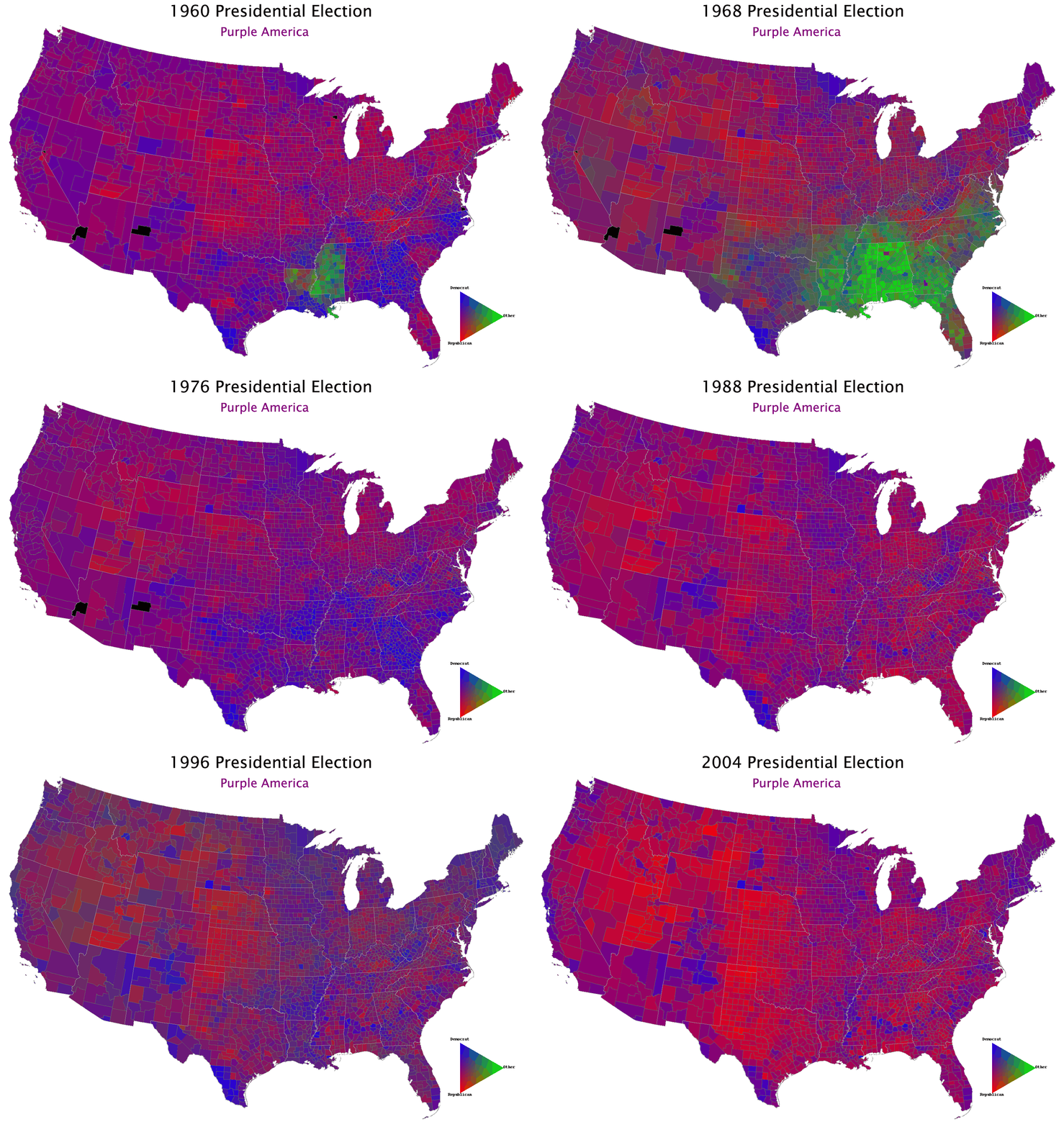
Here's a cool graph
showing presidential voting patterns over the last 40 years.

Both boys graduated this week, one from kindergarten and the other from eighth grade. It was a nice chance to reflect on how well they are both doing... lots of friends, well adjusted, good grades, all that stuff that parents like. Now, I realize that this can change all too quickly at this age, but given the train-wreck of my junior-high years, I am very, very pleased with them.

Friday, June 22, 2007

Christians and forced sex

(Post 13 in a series)
This doesn't get at what people do, but rather what is done to them. The data are, once again, from the NHSLS, and here the question is asked only of women:

% of women ever forced by a man to do something sexual.

31%, No religion
25%, Conservative protestants
21%, Mainline protestants
17%, Catholics

Sadly, these numbers are rather high, as these types of measures always are.

There does seem to be a religion difference, both comparing Christians to non-Christians and comparing between types of Christians.

Now, it would be interesting to know the religion of the male forcing the sex, but there does seem to be a lot of variation in who is forced.

Source: Michael et al. Sex in America 1994

Thursday, June 21, 2007

Chances of men winning arguments

What do you think, is this the way it is?

Wednesday, June 20, 2007

My financial prowess


As I have written before, I'm just not that good at managing money. I've always been good at making it, but somehow it all gets spent and turns into debt. With money, I'm sort of an idiot savant, without the savant part.

Here is the latest evidence:

My church is offering a great course on financial management, and both pastors took time to suggest that I take it. (Gosh, wonder why?) So, I signed up--10 weeks, $55 dollars. Okay. Then, my wife got a summer job, and the class was on a day I taught summer school, so it ended up being too disruptive to the family for us to go. (I actually think that was a good decision... family always first).

I did, however, get the seminar materials which included a good book about money, "Your Money Counts: The Biblical Guide to Earning, Spending, Saving, Investing, Giving, and Getting Out of Debt," which I think will be helpful.

Here's the rub: I just spent $55 for a book that retails for $12.99. Some people like to get discounts on their purchases... I like to pay 400% over retail.

Sigh...

Tuesday, June 19, 2007

Christians and the frequency & duration of sex


(Post 12 in a series)

Another measure of sexual behavior is the frequency and duration of sex: How often and for how long. Here are more data from the NHSLS.

The first number represents the average number of times they had sex in the previous month. The second number is the percentage for whom the last sexual event lasted 1 hour or more.

Men
7, 26% No religion
6, 18% Mainline protestant
7, 19% Conservative protestant
7, 19% Catholic

Women
6, 20% No religion
6, 12% Mainline protestant
7, 14% Conservative protestant
6, 16% Catholic

So, it looks like Christians have sex just as often as those with no-religion, but they take less time doing this.

This is quite likely due to differences in marriage rates. Only about 8-9% of the married people reported the last event lasting 1 hour or more; whereas, 30%-36% of the non-cohabitators reported the same.

Source: Sex in America, Michael et al. 1994, p. 137.

Monday, June 18, 2007

Religion, income, and voting

From Andrew Gellman's blog, here's an interesting graph on religion, income, and voting. (Thanks Corey for sending it to me!)

According to these data, people who did not attend church tended not to vote for Bush regardless of their income.

But... if they did attend church, their voting for Bush went up the more income they had.

Put differently, increased levels of income increased voting for Bush, but only among those who attended church. (This is something statisticians call an interaction effect. The effect of variable x on y varies by some other level z).


Any thoughts/explanations for this?

Saturday, June 16, 2007

Saturday stuff

Conversation in the car last week, between my wife and six-year-old son. He announced that he no longer wanted his piggy bank but instead he wanted a chicken bank. Cathy asked if piggy banks were for little kids. Floyd answered yes. Then he added that "chicken banks are for little kids too, but I like chickens."

I'm a big fan of Jay Livingston's blog. Here is his reaction to my post on professors and discrimination against evangelical students... much more sensible than anything I wrote.

One of our best graduate students, Andy Fullerton, who sometimes comments on this blog, just finished his Ph.D. and is off to a tenure-track job at Oklahoma State University. While we're all happy for him, we'll miss having him around. Though... it will save me some money. He routinely cleaned me out in our poker games. At times he would guess what I was holding, and he was almost always right. Good luck Andy!

My thirteen-year-old graduates from middle school this next week, and Cathy and I are *so* not ready for him to be in high school.

Today's grace: This morning I was walking by Floyd, and I happened to notice a tiny speck on his forehead. For whatever reason it caught my attention, and, sure enough, it was a tick. (Read: potential for Lyme disease). They are easy to remove, if you notice them.

Friday, June 15, 2007

Christianity and sexual satisfaction


(Post 11 in a series)

As a follow up to yesterday's post on orgasms, here are data from the NHSLS regarding self-reported measures of sexual satisfaction.

The percentage of respondents who said they are "extremely physically satisfied" with their partner.

Men
49%, Evangelical Protestants
48%, Mainline Protestants
44%, No religion
44%, Catholics
42%, Other religion

Women
44%, Evangelical Protestants
39%, Mainline Protestants
39%, Catholics
35%, No religion

Religion associated with good sex? Maybe prayer does work!

Source: The Social Organization of Sexuality, Laumann et al., p. 117.

Thursday, June 14, 2007

Christianity and the frequency of orgasms


(Post 10 in a series)

So far in this series, I have focused on sexual behavior in the context of immorality. Now, I'm going to turn to other sexual behaviors.

Much of these posts come from the National Health and Social Life Survey (NHSLS). This study, was conducted by Edward Laumann, of the University of Chicago, in 1994, so it's getting a bit old, but it remains about the best study on the topic. It collected data from 3,400+ people nationwide on just about every aspect of sexual behavior. Fortunately, for my purposes, it also collected data on religious affiliation.

From the NHSLS, here are the percentage of respondents who report "always having an orgasm" when they have sex with their primary partner.

Men
79%, Catholics
75%, no religious affiliation
75%, conservative protestants
73%, mainline protestants
66%, other religion

Women
33%, conservative protestants
27%, mainline protestants
27%, Catholics
22%, no religious affiliation

There isn't a lot of difference for men, but there looks to be a religious effect for women.

Maybe this explains why women tend to be much more religious than men?
Thoughts?

Tuesday, June 12, 2007

A review of the ASA Guide to Graduate Departments

Recently my colleague David Weakliem ordered the 2007 American Sociological Association Guide to Graduate Departments. It's basically a phonebook, organized by departments, of all faculty members in U.S. sociology departments.

After the order, the ASA sent David a standard message thanking him for ordering one of their books and inviting him to send them a review of it. Now... presumably this invitation is meant for more substantive works than a directory, but they did ask him. Here is his review:

"People say that War and Peace has a lot of characters, but it's nothing compared to this book. However, it does have a comprehensive index which is very helpful in keeping them all straight. The lack of depth in characterization was disappointing--people would appear and then disappear, never to be heard from again. Still, you have to admire the epic sweep of this work, and I'm looking forward to the author's next effort."

Maybe it's too much of an inside joke for non-sociologists, but I think it's really funny.

Monday, June 11, 2007

How many Christians are gay?

(Post 9 in a series)

(I posted these data in January, but I thought that I would repost them here as part of this series on Christians sexual behavior.)

The question: how many people, including Christians, are gay? (For discussion of terminology).

As background, in the 1940s, Alfred Kinsey and colleagues published a report claiming that about 10% of men are or had been exclusively gay. Though still cited, this statistic has been discredited. (For a discussion, see Joel Best, Damned Lies and Statistics, pp. 88-93). The most reliable estimates place the rate of same-sex orientation (depending on how it is measured) in the general population at from 1-4% (higher rates for any same-sex experience). See here and here. So, if there are about 200 million adults in the U.S., this means that from 2 - 8 million are gay.

To look at rates of sexual orientation among Christians, I used data from the National Survey of Midlife Development in the United States (MIDUS), 1995-1996. It sampled several thousand Americans aged 25-76, and it asked the following question:

How would you describe your sexual orientation? Would you say you are heterosexual (sexually attracted only to the opposite sex), homosexual (sexually attracted only to your own sex), or bisexual (sexually attracted to both men and women)?

Here are the rates by religious affiliation and activity. As per previous analyses in my divorce series, I define "frequent" as attending church about once a week or more often.

  • Frequent black protestant (n=90) 100.0% hetero-, 0% homo-, 0% bisexual
  • Frequent protestant (670) 99.1, 0.3, 0.6
  • Infrequent black protestant (88) 98.9, 0.0, 1.1
  • Frequent Catholic (413) 98.8, 0.7, 0.5
  • All respondents (3552) 97.3, 1.4, 1.3
  • Frequent other religion (73) 97.2, 1.4, 1.4
  • Infrequent Catholic (558) 97.1, 1.1, 1.8
  • Infrequent protestant (993) 96.9, 1.8, 1.3
  • Infrequent other religion (216) 95.8, 1.4, 2.8
  • No religion (363) 93.4, 4.1, 2.5

A caution in interpreting cross-sectional data

These data suggest the possibility that most Christians have relatively infrequent contact with gay people. I wonder if, and how, the controversy in the church about sexual orientation would change if Christians had regular, personal contact with gays, especially those who profess Christianity.

Next: Christians and frequency of orgasms

Sunday, June 10, 2007

Who will be in hell?

Ever wonder who will be in heaven, and, by extension, hell?

Here's English comedian's Rowan Atkinson's very funny answer.