Tuesday, December 11, 2007

What is beautiful is good stereotype

Like many people, you want to get ahead in life… have a successful career, be well-liked, you know, all that good stuff. So, you go to school, work hard, treat others well, and hope for the best.

Well, you’re forgetting something, and that is to look good. Why? It turns out that we attribute all sorts of positive qualities to good looking people, and these qualities have a way of becoming true.

Here’s how it works. Social psychologists have identified something called the “what is beautiful is good stereotype.” If someone is good looking—clear skin, symmetrical face, sparkly eyes or whatever else we see as beautiful or sexy or cute—we think that they are also lots of other good things. Just because they are hot, we think that they are more intelligent, sensitive, interesting, competent, and kind.

Our positive expectations for attractive people can serve as a self-fulfilling prophesy. If we think someone is smart and has a great personality, we start to treat them differently. We expect them to live up to our expectations, and, lo and behold, they do. As such, if we think that beautiful people are better people overall, they become so.

Usually we think about stereotypes being negative, and the problems that they cause. For example, if teachers think that girls are inherently worse at math than boys, they might put less effort into teaching them, call on them less in the class, and in general have lower expectations. The result, girls end up doing worse in math because the teachers think they will.

The “what is beautiful is good” stereotype is positive, and it can be just as powerful. In a classic study, researchers had men talk with a woman via intercom for 10 minutes, and after the conversation the men were asked to rate the woman’s personality. Half the men were shown a picture of an attractive woman and told that was the woman they were talking to. The other half were shown a picture of an unattractive woman. In reality, as you probably guessed, it was the same woman talking to each of the men.

The men who thought they were talking to an attractive woman rated her as more friendly, sociable, and likeable than those talking to an “unattractive” woman. They perceived her as having a much better personality just because she was beautiful. Why? Self-fulfilling prophesy. The men talking to the “attractive” woman treated had higher expectations for her, and she lived up to them.

The effect of this stereotype varies. As might be expected, it works most strongly with first impressions. We evaluate somebody’s appearance when we first meet them, and that information becomes most important. The more we get to know them, however, the more we factor in their other characteristics as well. Also, some people put more weight on physical appearances than others, and so they would be more affected by this stereotype.

This stereotype has various social implications. We’re all aware of the remarkable amounts of time and energy that people put into their appearance. Here in the U.S. alone, women spend billions of dollars on cosmetics. This seems like frivolity, but if in fact attractive people receive preferential treatment, it might not be as misguided as it first seems.

It also suggests another source of social stratification. Sociologists are quite attuned to how race, gender, sexuality, age, and other demographic characteristics affect our social standing. Perhaps we should to incorporate other characteristics, such as attractiveness. Who knows, maybe an attractive person of minority status might have better odds in society than an unattractive person of majority status.

This stereotype also gives an idea as to why the media so often uses attractive people. Open up any magazine, and there are beautiful people selling everything from vacuum cleaners to computers to watches. We see their attractiveness, and we associate other good qualities with them, and so maybe we should listen to them about what to buy.

An instance of this stereotype is found with newscasters. In general, television news anchors tend to be attractive people. Here are pictures of two of them. Stone Phillips is a reporter and anchor for CBS news. Melissa Theuriau is a reporter on French television. Both of them are remarkably attractive people. Now, it’s been awhile since I’ve walked through the journalism department here at UConn, but I’m pretty sure that average journalism student isn’t this good looking. News organizations pick anchors, in part, on their physical attractiveness, and given all the positive attributes associated with attractiveness, this isn’t a bad idea.

The beauty stereotype raises some interesting moral questions.

One could justifiably argue that it is wrong to give extra social capital to people because of their good looks. Somehow it seems unfair, almost discriminatory, to those of us who will never earn the name “Stone”. Still, the same argument applies to intelligence, education, organizational skills, and any other factors that society rewards. Some have more, some have less. Now, don’t get me wrong. If society rewarded only beauty, I’d be in deep, deep trouble. But, if society inherently conditions its rewards, i.e., some people get them and some people don’t, how much does it matter which criteria are used? The true alternative is unconditional value, no?

Originally posted at everydaysociologyblog.com

Sunday, December 09, 2007

Bah Humbug


I'm not a big fan of the Christmas season... okay, I flat out don't like it. The problem is that I have about a day-and-a-half worth of interest in it, but the darn thing goes on for a month and a half. There's no way that the "special" moments on Christmas morning justify the emotional and financial stress brought about by the season.

Furthermore, the days are getting shorter and shorter, which I find unnerving, and it's also Christmas time, so there is guilt by association.

So, here are some of the best things of a true bah humbug spirit:

Movie quotation
: "Christmas? Christmas means dinner, dinner means death! Death means carnage; Christmas means carnage!" Ferdinand the duck in Babe.

T-shirt slogan
: "What part of bah humbug don't you understand?"

Joke
: What did Jesus ever do for Santa Claus' birthday? (Steven Wright)

Photographs
: Bad Mall Santas


Song: Christmas time by Larry Norman

Santa Claus is coming and the kids are getting greedy
They know what's in the stores ´cause they seen it on the TV
You go into the forest and you cut down all the trees
I know you got a power saw, but who plants the seeds
I gotta buy a present, can´t remember who it´s for
I´ll see you in a hour when I get back from the store
It used to be the birthday of The Man who saved our necks
Now it stands for Santa Claus, they spell it with an "X"!
It´s Christmas time...

Any additions to this list?


Saturday, December 08, 2007

Bittersweet (pic)

Bittersweet is a real pain of a weed. It's a vine that grows everywhere; in fact, when we moved into this house, there were bittersweet vines covering 60 foot pine trees, all the way to the top.
Its one redeeming feature... it has beautiful berries in fall.

Friday, December 07, 2007

Soda pop as liquid Satan

A recent diet book termed soda pop as "liquid Satan" for how harmful it is to our health. I chuckled about the catchy term and didn't really think about it again, until... I read this narrative of what happens to our bodies when we drink a Coke. Yikes!

*******************
Have you ever wondered why Coke comes with a smile? It’s because it gets you high. They took the out almost a hundred years ago. You know why? It was redundant.
  • In The First 10 minutes: 10 teaspoons of sugar hit your system. (100% of your recommended daily intake.) You don’t immediately vomit from the overwhelming sweetness because phosphoric acid cuts the flavor allowing you to keep it down.
  • 20 minutes: Your sugar spikes, causing an insulin burst. Your liver responds to this by turning any sugar it can get its hands on into fat. (There’s plenty of that at this particular moment)
  • 40 minutes: Caffeine absorption is complete. Your pupils dilate, your pressure rises, as a response your livers dumps more sugar into your stream. The adenosine receptors in your brain are now blocked preventing drowsiness.
  • 45 minutes: Your body ups your dopamine production stimulating the pleasure centers of your brain. This is physically the same way crack works, by the way.
  • >60 minutes: The phosphoric acid binds calcium, magnesium and zinc in your lower intestine, providing a further boost in metabolism. This is compounded by high doses of sugar and artificial sweeteners also increasing the urinary excretion of calcium.
  • >60 Minutes: The caffeine’s diuretic properties come into play. (It makes you have to pee.) It is now assured that you’ll evacuate the bonded calcium, magnesium and zinc that was headed to your bones as well as sodium, electrolyte and water.
  • >60 minutes: As the rave inside of you dies down you’ll start to have a sugar crash. You may become irritable and/or sluggish. You’ve also now, literally, ed away all the water that was in the Coke. But not before infusing it with valuable nutrients your body could have used for things like even having the ability to hydrate your system or build strong bones and teeth.

This will all be followed by a caffeine crash in the next few hours. (As little as two if you’re a smoker.) But, hey, have another Coke, it’ll make you feel better.


Thursday, December 06, 2007

An end-of-the-semester question


Today was my last lecture in Sociology of Religion. I enjoyed teaching it, and really liked the students, but I came away from today asking a question:

Who looks forward to the end of the semester more? Students or professors.

I think it's professors because we don't risk graduating out of college into the real world.

What do you think?


Wednesday, December 05, 2007

Leaves in fog (pic)


A foggy night on the UConn campus....

Tuesday, December 04, 2007

Social balance theory at a barbeque

Something made me happy, and I didn’t understand why—at least until I remembered balance theory.

A friend and I are part of a group, and this group held a barbeque. Now, I didn’t want to go because I thought it would be kind of boring. My friend, however, not only went but he also organized it, and for some reason this bothered me. The next week I spoke with him about the event, and not only did he not have fun, but it turns out that he helped organize it out of obligation. When I heard this I was happy for the rest of the afternoon.

Why in the world would my friend not having fun make me happy? I don’t normally feed off of other people's misery. I didn’t have to go to the barbeque, so why should I care?

I suppose that I could be devolving into a petty, mean-spirited sociologist, but a more optimistic explanation comes from what social psychologists term balance theory. The best way to illustrate balance theory is with social situations with three elements: You (Person 1), somebody else (Person 2), and some object.

Balance is good, and it happens when Person 1 likes Person 2, and they both like some object. We can chart this out this way:See all the good feelings? This provides balance because not only does Person 1 like Person 2, but they also agree with them about the object.

Another balanced situation would be if Person 1 did not like either Person 2 or the object, but person 2 liked the object. Here Person 1’s low esteem of Person 2 is validated by their disagreement about the object. (There are several other balanced situations… can you figure them out? They all have only one positive relationship.)

Balanced situations tend to stay rather stable because there is no overt reason to change them.

In contrast, imbalance can be bad, and it often occurs in situations where there is tension in the feelings involved. For example, say Person 1 likes Person 2 but does not like an object. Person 2, however, does like the object. This causes tension for person 1 because their good feelings toward Person 2 don’t match their disagreement about the object. Here’s how we can chart this imbalance:
Do you see the problem? The imbalanced described here creates instability. Because of this, imbalanced situations usually don’t last too long; their tension motivates the people involved to balance the situation.

In the above imbalanced situation, balance could be achieved in several ways: Person 1 could decide to like the object or they could dislike Person 2 or Person 2 could dislike the object. Any one of these changes would work equally well, and usually the easiest change is made. There are three relationships described in this situation, and whichever one is weakest will probably be the one changed.

This is what happened in my situation. I (Person 1) liked my friend (Person 2) and not the barbeque (object), but he seemed to like the barbeque. This imbalance was bothering me, and I had several choices in how to create balance. I could decide that the barbeque was a fun thing after all or that I didn’t really like my friend. I could also try to persuade my friend to dislike the barbeque.

None of these were particularly good options, so I was stuck. That is why I was happy when I found out that he actually did not enjoy the barbeque and was involved only out of obligation. This created a balanced situation :
Whew, that was a close one!

The reason that sociologists like balance theory isn’t just because it helps us to understand our friends and barbeques. It also provides an interesting idea about how we form our attitudes.

Usually people think that their attitudes toward somebody or something are their own. You feel a certain way because that’s who you are—an individualistic, psychological explanation. Certainly people have their own preferences, but in addition our attitudes and opinions are shaped by what others around us think and our desire not to be in conflict with those we like (or to be in conflict with those we don’t like).

Think about some of your attitudes. What are some of the things you like—bands? Restaurants? Styles of clothes? Sports teams? You may be proud of what you like, even use it to define yourself—wearing logos or joining different Facebook groups. Examine these attitudes and see how they fit with your friends’ (or enemies’) attitudes. I’ll bet you pretty much agree with your friends and disagree—or want to disagree—with people you don’t like.

It turns out that some of these things may simply reflect your desire to have cognitive balance. Your attitudes may reflect the attitudes of others as much as they reflect you.

Monday, December 03, 2007

A new reality show

Now this sounds like an interesting reality show. In it, non-Muslims living under strict Sharia law for three weeks.

There's some controversy about whether it will increase acceptance of Muslims or promote intolerance.

It would certainly be a different experience, especially for Western women.

What do you think it will do?

Sunday, December 02, 2007

Deer on ice


I was out this a.m. taking photos at a local lake, when I heard something crashing through the brush. I looked over, and saw a buck flying through the woods (maybe running away from hunters?).

It ran on the the ice, had a hoof fall through, stuggled his way free, and then lay there on the ice to catch his breath.

Me? I was on the other shore, already set up, snapping away. Here's a nice picture of it...

Saturday, December 01, 2007

Saturday stuff

Ben Dubow has published a thoughtful post on the discussion of Willow Creek's Reveal study on the blogosphere. He addresses it from a pastor's perspective of what works and what doesn't.

Here's a funny story about how the misuse of an on-line translator, caused a diplomatic uproar. (Thanks David)


It was really foggy last week, so what was I doing? Going out late and night and sneaking up on geese at Mirror Lake here on campus.

Thursday, November 29, 2007

Church Surveys: Willow Creek's Reveal Study, Summary

Summary of this series
(Post 11 in an 11-part series)

I would summarize this series on Willow Creek’s Reveal study with four points.

1) Well done. Collecting survey data is a powerful but virtually unused tool in the world of Christian churches. By conducting Reveal, Willow Creek has modeled to other churches the usefulness of church surveys, and given Willow’s influence in American Christendom, I would hope that this message takes hold.

2) Weaknesses. As with any survey, Reveal has its weaknesses. The cross-sectional design of its sample (i.e., a one-time snapshot) limits the conclusions that can be drawn from the data. Also, the authors use of “maximizing predictability,” a technique apparently popular in brand marketing studies, doesn’t fit well with studies of human behavior. Reveal constitutes a good pilot study that should prepare the way for more definitive studies in the future.

3) Overinterpretation of the data. The conclusion draw by the study’s authors, and loudly echoed by critics of Willow Creek, is that the Willow model is flawed. The data presented here are sufficiently ambiguous to make such strong claims. Given the weaknesses of the study design and analytic strategy, it’s possible that the results indicate strong support for the Willow Creek model.

4) Future studies. Simply repeating the Reveal study with hundreds more churches potentially adds very little knowledge. Much better would be a smaller, longitudinal study of, say, a thousand respondents. If many churches are studied, measure characteristics of the churches as a whole as well as of individuals.

I hope that this series has been helpful to the authors and readers of Reveal. In academics, critical attention is a form of flattery indicating that the discussed work —it indicates that one thinks a work is worth consideration. I believe that Reveal will be looked back upon as an important step in the American Christian Church discovering the value of empirical data.


To start the series

Wednesday, November 28, 2007

Church Surveys: Willow Creek's Reveal Study, X

Suggestions for future Reveal studies.
(Post 10 in an 11-part series)

The Reveal Study, conducted by Willow Creek Church, used what sociologists call a cross-sectional survey to collect data at one point in time. Think of it as a snap-shot of life at Willow during the time of the survey.

A cross-sectional survey was a good choice to get the Reveal program going, for it is an inexpensive method to collect data, and it’s a good way to test measures and start exploring a phenomenon.

Cross-sectional surveys, however, have some inherent weaknesses. They don’t do a good job in describing how processes work over time—think of trying to document a child’s growth by taking a picture at only one point in time. This matters because some of Reveal’s hypotheses are longitudinal—over time—in nature. One example is the idea that as Christians should act differently as they become more mature in their faith.

Another weakness with cross-sectional studies regards causality. When we want to say that “A” causes “B”, we usually assume that “A” precedes “B” in time (short of having a time machine). As such, we would like to measure “A” at an earlier time than “B” to lessen the chance of reverse causation—“B” causing “A.” (There’s more to establishing causality, but it’s not worth going into here).

It’s in this context that we might review Reveal’s plans for the future. As described in the book, the study’s authors plan to give the current Reveal study in 500 other churches. By doing this they could easily get up to 50,000 respondents (figuring 100 per church). The value of doing this is that they can replicate the Reveal study in other contexts, other than just Willow (and the other six churches surveyed originally). This should broaden the generalizability of the findings (something sociologists call external validity).

Nonetheless, this next phase of Reveal isn’t necessarily a big step forward for two reasons. 1) It is still saddled with the limitations of cross-sectional studies, and 2) the extra sample size by itself doesn’t make much of a difference. The value of having bigger samples is that they give more certainty in the accuracy of the resulting statistics (called statistical power). However, for a study like this, a sample of several thousand is more than enough, and the additional tens of thousands of respondents won’t really make much a difference. It doesn’t make things worse, but it doesn’t much increase the validity of the data.

What then would I recommend for Reveal? Three things.

1) Consider conducting a longitudinal study. The best way to test Reveal’s ideas would be to conduct a longitudinal study by observing some people over time. For example, recruit 1,000 people at Willow Creek. Some who are there for their first Sunday, some who have been there for years, and some in between. Collect information about them, such as is already collected in Reveal. Then wait six months to a year and collect the same information about them. Maybe wait another time period and do it again. At the end, you’ll have data to test how people change over time in response to being at Willow Creek. You can test what stages people go through, and how they change with time in the church. These would be fascinating data, and I don’t know of any church that has collected them.

2) Collect church-level measures. As I discuss above, the additional tens of thousands of respondents in the next phase of Reveal really don’t buy much in terms of statistical power. What would be useful, however, would be to collect data about the 500 churches themselves. Record data such as:
- how big is the church
- what size town is it in
- how many pastors do they have
- do they have a “seeker-sensitive” approach to ministry
- what is their budget
- what percentage of their leadership are women or racial minorities
- anything other church characteristic that might affect the individuals’ experiences at a church

With sufficient church-level measures, the Reveal authors could then conduct what is called a multi-level analysis. They could examine which individual characteristics make a difference versus which church characteristics.

The classic example of multi-level analysis comes from educational studies. If a child succeeds in education, it could be due to who they are as students—smart, hard working, high goals, etc. Success could also be due to the school they go to—low teacher/student ratio, highly educated and paid teachers, fellow students who are going to college, etc. Or, it could be both the child and the school.

Multi-level education studies pick a series of schools, measuring school characteristics, and then pick individual students within those schools, measuring individual characteristics. They then analyze these multi-level data using various statistical techniques (such as “hierarchical linear modeling”).

The result: A reasonably clear statement about whether it’s the person, the organization, or both that affect individual outcomes.

3) Draw from social science. The analytic approach used in Reveal comes from business marketing studies, and this poses some problems when applied to people, for people are a more complex unit of study than most business products.

Consider studying perfume sales at a department store versus people’s behavior. A bottle of perfume won’t up and leave by itself if it doesn’t like where it is placed. People will change due to situations if they are unhappy. A bottle of perfume won’t be different if it is surrounded by other bottles of perfume. People are different depending on who’s around them. The actual contents of a perfume bottle don’t change depending on what people think of it. People do change based on other peoples’ opinions.

As described in Reveal, the driving analytic strategy in marketing/ business studies is “maximizing predictability.” This means identifying which predictor variables best predict the outcome variable (it’s also called “maximizing explained variance”). In sociology this is generally in sociology this is considered a not a good idea when it comes to people, for it capitalizes on chance, potentially amplifies measurement and sampling error, and produces less interesting results.

There are plenty of social scientists who apply the latest statistical and sampling methods in applying religious behaviors, and Willow Creek should get some of these people are board. To see the difference between a social science approach and the marketing approach of Reveal, pick up any book by Christian Smith, a sociologist at Notre Dame. He’s about the best in the business when it comes to surveys about religion, and his work produces simple, clear, believable findings.

These three suggestions would substantially increase the power and importance of the Reveal study, helping it to further achieve its laudable goals of helping the church grow.

Tuesday, November 27, 2007

Church Surveys: Willow Creek's Reveal Study, IX

Stalled believers?
(Post 9 in an 11-part series)

I want to follow-up on yesterday’s post. A key finding in Reveal is that a good portion (up to 25%) were mature believers who said that they were stalled in their spiritual walk. This has been used as an indictment of the Willow Creek , with its focus on bringing seekers into the church.

As we think more deeply about this finding, however, it may not be problematic for two reasons.

1) Is stalled bad? It’s my distinct impression that spiritual growth is not linear, rather it goes up in fits in starts: sudden increases followed by long plateaus.

This type of growth pattern would seem to fit better with most other areas of life as well, such as getting better at a sport, learning a hobby, growing together as a couple, and advancing in a career. Other than my gaining weight during the holidays, I can think of very little in my life that is truly linear.

In my own experience, the times of feeling stalled—being at a plateau—have in retrospect proven to be fruitful (as well as difficult). Part of the Christian walk, I think, is hanging on during these difficult times.

As such, the finding that some portion of the mature believers in Reveal report themselves as stalled may just reflect the realities of Christian life. My guess is that Mother Theresa, if she had taken the Reveal study, would have frequently placed herself into the “stalled” category (thanks Mat for this point).

I think that most Christians go through extended periods of feeling flat, and not only is the way it is, it might also be the way it should be.

2) Regression to the mean. A powerful but often overlooked statistical principle is that of “regression to the mean.” This principle states that whenever you measure a person or group of people with extreme scores on some scale, you can expect them, on average, to become less extreme—return toward the mean—over time. This is because extreme scores result from both stable and unstable characteristics, and the unstable change over time. To read more click here.

Here are some examples of regression to the mean:
- The college football season is about ready to end (sadly). We can be pretty sure that next season the top twenty teams of this season won’t do as well, and the bottom twenty teams will do better. They will regress to the mean.
- Very tall parents will usually have children who are shorter than they are, and very short parents will usually have children taller than they. (As trivia, the name given to “regression analysis” is based on this finding).
- The top mutual funds this year probably won’t perform as well next year, and the worst mutual funds will probably perform better (though maybe not well).

What does this mean for church surveys such as Reveal? We can almost always expect that a group of Christians who have done really well in the past will probably not do as well in the future, and the group who has done the worst will probably do better.

As such, church surveys will probably routinely find that the most active, mature members are getting worse, and the newest, least experienced members are overall getting better. If so, this may not be a flaw in ministry plans, but rather just a reflection of regression to the mean.

Does this mean that churches should not target special programs for mature, active believers? Of course not. Rather, an overall downward trend among those doing best can always be expected.

Next: Suggestions for future research

To start the series

To read the final summary

Monday, November 26, 2007

Church Surveys: Willow Creek's Reveal Study, VIII

Over-interpreting the data?
(Post 8 in an 11-part series)

In my last post, I discussed one of Reveal's two major criticisms of Willow Creek Church, a moderate relationship between church activities and spiritual growth. Here I discuss the second major criticism--that a significant minority of sample members described themselves as spiritually stagnant or were dissatisfied with their church. As shown in this figure, about 1/4 of the sample identified labeled themselves as either dissatisfied or stagnant.


This statistic highlights the problem posed by Reveal not having a comparison group, for we don't know if it's good or bad.

Let's say I told you that a sports player was successful at two-thirds of what they attempted, and then I asked you if this is good. Well, you would need to know how everyone else does. If it's free throws, this isn't very good. If it's completing passes, this is very good. If it's getting on base, it's the best ever.

It may be the nature of Christian life that 1/3 of the people are stalled or dissatisfied.

or

It may be that this number is high, suggesting that Willow needs to improve

or

It may be that this number is low, suggesting that Willow is doing a great job.

There's another wrinkle here: Church involvement is voluntary. So, why would a dissatisfied, stalled person be involved? It suggests that there may be other benefits or ties that come into play.

What if a church found that 100% of its attendees were satisfied and growing. Would this be good? Maybe but maybe not. What if the church didn't attract people unintentionally drove off or otherwise couldn't keep people who were having troubles or were unhappy? That would produce high satisfaction scores, but it might be missing the larger purpose of the Church.

In this sense, Willow might be commended for holding on to these people.

Again, it's not that Reveal did anything wrong in collecting these data or that it collected them badly. Rather, the concern here is over-interpretation. These data should suggest future work, but by themselves they are not sufficient to justify wide scale changes in an organization as successful as Willow Creek.

Saturday, November 24, 2007

Full moon (pics)

There was a cool full moon tonight, so I went out and took some pictures. (It was kind of weird lurking around the graveyard).


Friday, November 23, 2007

Distribution of mega-churches in the US

Here's an interesting map of where mega-churches are located in the U.S. There are 1,300 churches with at least 2,000 in weekly attendance.
Compare this map with a US population map...

I was struck by how similar the maps look. I would have expected more regional differences.

Thursday, November 22, 2007

Wednesday, November 21, 2007

Church Surveys: Willow Creek's Reveal Study, VII

Is the Willow Creek flawed?
(Post 7 in an 11-post series)

The big story to come out of Willow Creek's Reveal Study is that the seeker-sensitive ministry made famous by Willow is supposedly flawed and ineffective. This is based on two findings, the first of which I’ll post on today:

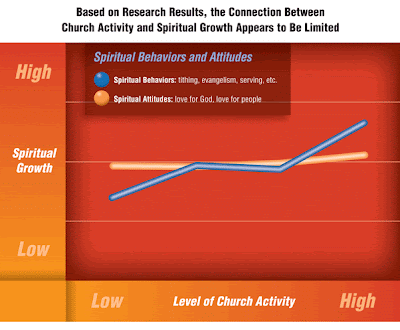
The first finding is that levels of participation in church activities didn't predict measures of spiritual growth. As shown in this graph, the relationship between church activity and spiritual growth appears modest at best.


These findings seem to have hit the leadership of Willow really hard. From the Christianity Today blog,

"Having spent thirty years creating and promoting a multi-million dollar organization driven by programs and measuring participation, and convincing other church leaders to do the same, you can see why Hybels called this research “the wake up call” of his life.
Hybels confesses:

'We made a mistake. What we should have done when people crossed the line of faith and become Christians, we should have started telling people and teaching people that they have to take responsibility to become ‘self feeders.’ We should have gotten people, taught people, how to read their bible between service, how to do the spiritual practices much more aggressively on their own.'"

Critics of Willow have seized upon this admission to term the Willow as deeply flawed.

Is the Willow Creek actually flawed? Maybe, maybe not, but we can't tell from these data for several reasons.

1) How steep a line? As per the chart printed above, both spiritual behaviors increase somewhat with church activities while spiritual attitudes don’t really. The fact that increased church activity correlates with moderate growth is a good sign for Willow. Maybe it’s not as steep a line as they expected, but it’s still going up. They found a much steeper line using a spiritual continuum to predict spiritual growth, but as I posted previously, this may not be a particularly interesting finding. It could be that this is as big effect as can be realistically expected, which leads me to the second point.

2) Compared to what? To judge the effectiveness of any program, you need to compare it to something. For example, if we give a pill to people with some disease, and 25% of the pass away, does the pill work? The answer: We don’t know, and we have to ask what would have happened if they didn’t take the pill. There are several useful comparisons for a study such as Reveal. A) What would have happened to the people if they had not attended church activities? B) What would have happened if they had attended church activities elsewhere? C) What would have happened if they had attended a different level of church activities? The Reveal study ignores the first two comparisons and uses cross-sectional data to approximate the third one. This raises another issue…

3) Contamination. People talk to each other, they learn from each other. In a religious community such as Willow Creek, what is taught to one group of people affects others as well. As such, the impact of programs on high-activity people will probably be spread to low-activity people as well. This effect on low-activity people could change their behavior to make it more similar to the high-activity people, giving the false impression that the activities don’t actually work.

In reality, the ideas being tested here operate at the church-wide level, i.e., is Willow Creek effective as a church? To fully test this question, in turn, requires church level data. For example, find 100 churches, 50 that subscribe to the Willow Creek and 50 that don’t. How are they different? How are they the same? (Ideally you would randomly assign which churches get the Willow Creek but this gets difficult).

4) Activity and maturity. Another interpretation of these data goes as follows. Maybe the individuals who have recently started attending church, especially if they are new Christians, are also the most active in its activities. With time they grow spiritually, but they also settle down into a routine involving fewer activities. This would mask the correlation between church activity and spiritual growth, even if church activities were effective.

It appears that the Reveal Study is over-interpreting the data. The big changes apparently in place at Willow as the result of Reveal may in fact not be warranted. In short, they may be fixing something that isn’t broken.

Here’s an analogy. If someone feels a lump under their arm, they would be rightly concerned about the possibility of cancer. What they should not do, however, is immediately start full-scale cancer treatment such as chemotherapy. What they should do is get a better test, such as a biopsy, to find out if the lump is cancerous and then decide what to do—the lump may be something else.

The findings of the Reveal Study perhaps suggest problems with the Willow , but they may not. They are inherently limited by the cross-sectional design and other features of the study. A more careful look using a more powerful survey design is warranted before an institution as successful as Willow makes serious changes.

Next: Overinterpreting the data?

To start the series

To read the final summary

The problem of porn

Father Lou DelFra writing about pornography highlights some of its negative consequences for college students (and anyone for that matter). He makes a very interesting point:

"Perhaps the most pernicious consequence that students have struggled with is that, over time, repeated pornography use threatens to turn sexuality into an enemy. Students who struggle with pornography frequently talk about their sexuality primarily as something they need to overcome. In fact, it is the use of pornography they are so desperate to overcome, but often this slips into a general adversarial relationship with one's entire sexuality. This is squarely at odds with the life - including the sexual life - that God, who gifted us with our sexuality, intends for us. We are not created to be enemies of the gifts which God has planted deep within us."

Thanks Susie for the link