Thursday, December 06, 2007

An end-of-the-semester question


Today was my last lecture in Sociology of Religion. I enjoyed teaching it, and really liked the students, but I came away from today asking a question:

Who looks forward to the end of the semester more? Students or professors.

I think it's professors because we don't risk graduating out of college into the real world.

What do you think?


Wednesday, December 05, 2007

Leaves in fog (pic)


A foggy night on the UConn campus....

Tuesday, December 04, 2007

Social balance theory at a barbeque

Something made me happy, and I didn’t understand why—at least until I remembered balance theory.

A friend and I are part of a group, and this group held a barbeque. Now, I didn’t want to go because I thought it would be kind of boring. My friend, however, not only went but he also organized it, and for some reason this bothered me. The next week I spoke with him about the event, and not only did he not have fun, but it turns out that he helped organize it out of obligation. When I heard this I was happy for the rest of the afternoon.

Why in the world would my friend not having fun make me happy? I don’t normally feed off of other people's misery. I didn’t have to go to the barbeque, so why should I care?

I suppose that I could be devolving into a petty, mean-spirited sociologist, but a more optimistic explanation comes from what social psychologists term balance theory. The best way to illustrate balance theory is with social situations with three elements: You (Person 1), somebody else (Person 2), and some object.

Balance is good, and it happens when Person 1 likes Person 2, and they both like some object. We can chart this out this way:See all the good feelings? This provides balance because not only does Person 1 like Person 2, but they also agree with them about the object.

Another balanced situation would be if Person 1 did not like either Person 2 or the object, but person 2 liked the object. Here Person 1’s low esteem of Person 2 is validated by their disagreement about the object. (There are several other balanced situations… can you figure them out? They all have only one positive relationship.)

Balanced situations tend to stay rather stable because there is no overt reason to change them.

In contrast, imbalance can be bad, and it often occurs in situations where there is tension in the feelings involved. For example, say Person 1 likes Person 2 but does not like an object. Person 2, however, does like the object. This causes tension for person 1 because their good feelings toward Person 2 don’t match their disagreement about the object. Here’s how we can chart this imbalance:
Do you see the problem? The imbalanced described here creates instability. Because of this, imbalanced situations usually don’t last too long; their tension motivates the people involved to balance the situation.

In the above imbalanced situation, balance could be achieved in several ways: Person 1 could decide to like the object or they could dislike Person 2 or Person 2 could dislike the object. Any one of these changes would work equally well, and usually the easiest change is made. There are three relationships described in this situation, and whichever one is weakest will probably be the one changed.

This is what happened in my situation. I (Person 1) liked my friend (Person 2) and not the barbeque (object), but he seemed to like the barbeque. This imbalance was bothering me, and I had several choices in how to create balance. I could decide that the barbeque was a fun thing after all or that I didn’t really like my friend. I could also try to persuade my friend to dislike the barbeque.

None of these were particularly good options, so I was stuck. That is why I was happy when I found out that he actually did not enjoy the barbeque and was involved only out of obligation. This created a balanced situation :
Whew, that was a close one!

The reason that sociologists like balance theory isn’t just because it helps us to understand our friends and barbeques. It also provides an interesting idea about how we form our attitudes.

Usually people think that their attitudes toward somebody or something are their own. You feel a certain way because that’s who you are—an individualistic, psychological explanation. Certainly people have their own preferences, but in addition our attitudes and opinions are shaped by what others around us think and our desire not to be in conflict with those we like (or to be in conflict with those we don’t like).

Think about some of your attitudes. What are some of the things you like—bands? Restaurants? Styles of clothes? Sports teams? You may be proud of what you like, even use it to define yourself—wearing logos or joining different Facebook groups. Examine these attitudes and see how they fit with your friends’ (or enemies’) attitudes. I’ll bet you pretty much agree with your friends and disagree—or want to disagree—with people you don’t like.

It turns out that some of these things may simply reflect your desire to have cognitive balance. Your attitudes may reflect the attitudes of others as much as they reflect you.

Monday, December 03, 2007

A new reality show

Now this sounds like an interesting reality show. In it, non-Muslims living under strict Sharia law for three weeks.

There's some controversy about whether it will increase acceptance of Muslims or promote intolerance.

It would certainly be a different experience, especially for Western women.

What do you think it will do?

Sunday, December 02, 2007

Deer on ice


I was out this a.m. taking photos at a local lake, when I heard something crashing through the brush. I looked over, and saw a buck flying through the woods (maybe running away from hunters?).

It ran on the the ice, had a hoof fall through, stuggled his way free, and then lay there on the ice to catch his breath.

Me? I was on the other shore, already set up, snapping away. Here's a nice picture of it...

Saturday, December 01, 2007

Saturday stuff

Ben Dubow has published a thoughtful post on the discussion of Willow Creek's Reveal study on the blogosphere. He addresses it from a pastor's perspective of what works and what doesn't.

Here's a funny story about how the misuse of an on-line translator, caused a diplomatic uproar. (Thanks David)


It was really foggy last week, so what was I doing? Going out late and night and sneaking up on geese at Mirror Lake here on campus.

Thursday, November 29, 2007

Church Surveys: Willow Creek's Reveal Study, Summary

Summary of this series
(Post 11 in an 11-part series)

I would summarize this series on Willow Creek’s Reveal study with four points.

1) Well done. Collecting survey data is a powerful but virtually unused tool in the world of Christian churches. By conducting Reveal, Willow Creek has modeled to other churches the usefulness of church surveys, and given Willow’s influence in American Christendom, I would hope that this message takes hold.

2) Weaknesses. As with any survey, Reveal has its weaknesses. The cross-sectional design of its sample (i.e., a one-time snapshot) limits the conclusions that can be drawn from the data. Also, the authors use of “maximizing predictability,” a technique apparently popular in brand marketing studies, doesn’t fit well with studies of human behavior. Reveal constitutes a good pilot study that should prepare the way for more definitive studies in the future.

3) Overinterpretation of the data. The conclusion draw by the study’s authors, and loudly echoed by critics of Willow Creek, is that the Willow model is flawed. The data presented here are sufficiently ambiguous to make such strong claims. Given the weaknesses of the study design and analytic strategy, it’s possible that the results indicate strong support for the Willow Creek model.

4) Future studies. Simply repeating the Reveal study with hundreds more churches potentially adds very little knowledge. Much better would be a smaller, longitudinal study of, say, a thousand respondents. If many churches are studied, measure characteristics of the churches as a whole as well as of individuals.

I hope that this series has been helpful to the authors and readers of Reveal. In academics, critical attention is a form of flattery indicating that the discussed work —it indicates that one thinks a work is worth consideration. I believe that Reveal will be looked back upon as an important step in the American Christian Church discovering the value of empirical data.


To start the series

Wednesday, November 28, 2007

Church Surveys: Willow Creek's Reveal Study, X

Suggestions for future Reveal studies.
(Post 10 in an 11-part series)

The Reveal Study, conducted by Willow Creek Church, used what sociologists call a cross-sectional survey to collect data at one point in time. Think of it as a snap-shot of life at Willow during the time of the survey.

A cross-sectional survey was a good choice to get the Reveal program going, for it is an inexpensive method to collect data, and it’s a good way to test measures and start exploring a phenomenon.

Cross-sectional surveys, however, have some inherent weaknesses. They don’t do a good job in describing how processes work over time—think of trying to document a child’s growth by taking a picture at only one point in time. This matters because some of Reveal’s hypotheses are longitudinal—over time—in nature. One example is the idea that as Christians should act differently as they become more mature in their faith.

Another weakness with cross-sectional studies regards causality. When we want to say that “A” causes “B”, we usually assume that “A” precedes “B” in time (short of having a time machine). As such, we would like to measure “A” at an earlier time than “B” to lessen the chance of reverse causation—“B” causing “A.” (There’s more to establishing causality, but it’s not worth going into here).

It’s in this context that we might review Reveal’s plans for the future. As described in the book, the study’s authors plan to give the current Reveal study in 500 other churches. By doing this they could easily get up to 50,000 respondents (figuring 100 per church). The value of doing this is that they can replicate the Reveal study in other contexts, other than just Willow (and the other six churches surveyed originally). This should broaden the generalizability of the findings (something sociologists call external validity).

Nonetheless, this next phase of Reveal isn’t necessarily a big step forward for two reasons. 1) It is still saddled with the limitations of cross-sectional studies, and 2) the extra sample size by itself doesn’t make much of a difference. The value of having bigger samples is that they give more certainty in the accuracy of the resulting statistics (called statistical power). However, for a study like this, a sample of several thousand is more than enough, and the additional tens of thousands of respondents won’t really make much a difference. It doesn’t make things worse, but it doesn’t much increase the validity of the data.

What then would I recommend for Reveal? Three things.

1) Consider conducting a longitudinal study. The best way to test Reveal’s ideas would be to conduct a longitudinal study by observing some people over time. For example, recruit 1,000 people at Willow Creek. Some who are there for their first Sunday, some who have been there for years, and some in between. Collect information about them, such as is already collected in Reveal. Then wait six months to a year and collect the same information about them. Maybe wait another time period and do it again. At the end, you’ll have data to test how people change over time in response to being at Willow Creek. You can test what stages people go through, and how they change with time in the church. These would be fascinating data, and I don’t know of any church that has collected them.

2) Collect church-level measures. As I discuss above, the additional tens of thousands of respondents in the next phase of Reveal really don’t buy much in terms of statistical power. What would be useful, however, would be to collect data about the 500 churches themselves. Record data such as:
- how big is the church
- what size town is it in
- how many pastors do they have
- do they have a “seeker-sensitive” approach to ministry
- what is their budget
- what percentage of their leadership are women or racial minorities
- anything other church characteristic that might affect the individuals’ experiences at a church

With sufficient church-level measures, the Reveal authors could then conduct what is called a multi-level analysis. They could examine which individual characteristics make a difference versus which church characteristics.

The classic example of multi-level analysis comes from educational studies. If a child succeeds in education, it could be due to who they are as students—smart, hard working, high goals, etc. Success could also be due to the school they go to—low teacher/student ratio, highly educated and paid teachers, fellow students who are going to college, etc. Or, it could be both the child and the school.

Multi-level education studies pick a series of schools, measuring school characteristics, and then pick individual students within those schools, measuring individual characteristics. They then analyze these multi-level data using various statistical techniques (such as “hierarchical linear modeling”).

The result: A reasonably clear statement about whether it’s the person, the organization, or both that affect individual outcomes.

3) Draw from social science. The analytic approach used in Reveal comes from business marketing studies, and this poses some problems when applied to people, for people are a more complex unit of study than most business products.

Consider studying perfume sales at a department store versus people’s behavior. A bottle of perfume won’t up and leave by itself if it doesn’t like where it is placed. People will change due to situations if they are unhappy. A bottle of perfume won’t be different if it is surrounded by other bottles of perfume. People are different depending on who’s around them. The actual contents of a perfume bottle don’t change depending on what people think of it. People do change based on other peoples’ opinions.

As described in Reveal, the driving analytic strategy in marketing/ business studies is “maximizing predictability.” This means identifying which predictor variables best predict the outcome variable (it’s also called “maximizing explained variance”). In sociology this is generally in sociology this is considered a not a good idea when it comes to people, for it capitalizes on chance, potentially amplifies measurement and sampling error, and produces less interesting results.

There are plenty of social scientists who apply the latest statistical and sampling methods in applying religious behaviors, and Willow Creek should get some of these people are board. To see the difference between a social science approach and the marketing approach of Reveal, pick up any book by Christian Smith, a sociologist at Notre Dame. He’s about the best in the business when it comes to surveys about religion, and his work produces simple, clear, believable findings.

These three suggestions would substantially increase the power and importance of the Reveal study, helping it to further achieve its laudable goals of helping the church grow.

Tuesday, November 27, 2007

Church Surveys: Willow Creek's Reveal Study, IX

Stalled believers?
(Post 9 in an 11-part series)

I want to follow-up on yesterday’s post. A key finding in Reveal is that a good portion (up to 25%) were mature believers who said that they were stalled in their spiritual walk. This has been used as an indictment of the Willow Creek , with its focus on bringing seekers into the church.

As we think more deeply about this finding, however, it may not be problematic for two reasons.

1) Is stalled bad? It’s my distinct impression that spiritual growth is not linear, rather it goes up in fits in starts: sudden increases followed by long plateaus.

This type of growth pattern would seem to fit better with most other areas of life as well, such as getting better at a sport, learning a hobby, growing together as a couple, and advancing in a career. Other than my gaining weight during the holidays, I can think of very little in my life that is truly linear.

In my own experience, the times of feeling stalled—being at a plateau—have in retrospect proven to be fruitful (as well as difficult). Part of the Christian walk, I think, is hanging on during these difficult times.

As such, the finding that some portion of the mature believers in Reveal report themselves as stalled may just reflect the realities of Christian life. My guess is that Mother Theresa, if she had taken the Reveal study, would have frequently placed herself into the “stalled” category (thanks Mat for this point).

I think that most Christians go through extended periods of feeling flat, and not only is the way it is, it might also be the way it should be.

2) Regression to the mean. A powerful but often overlooked statistical principle is that of “regression to the mean.” This principle states that whenever you measure a person or group of people with extreme scores on some scale, you can expect them, on average, to become less extreme—return toward the mean—over time. This is because extreme scores result from both stable and unstable characteristics, and the unstable change over time. To read more click here.

Here are some examples of regression to the mean:
- The college football season is about ready to end (sadly). We can be pretty sure that next season the top twenty teams of this season won’t do as well, and the bottom twenty teams will do better. They will regress to the mean.
- Very tall parents will usually have children who are shorter than they are, and very short parents will usually have children taller than they. (As trivia, the name given to “regression analysis” is based on this finding).
- The top mutual funds this year probably won’t perform as well next year, and the worst mutual funds will probably perform better (though maybe not well).

What does this mean for church surveys such as Reveal? We can almost always expect that a group of Christians who have done really well in the past will probably not do as well in the future, and the group who has done the worst will probably do better.

As such, church surveys will probably routinely find that the most active, mature members are getting worse, and the newest, least experienced members are overall getting better. If so, this may not be a flaw in ministry plans, but rather just a reflection of regression to the mean.

Does this mean that churches should not target special programs for mature, active believers? Of course not. Rather, an overall downward trend among those doing best can always be expected.

Next: Suggestions for future research

To start the series

To read the final summary

Monday, November 26, 2007

Church Surveys: Willow Creek's Reveal Study, VIII

Over-interpreting the data?
(Post 8 in an 11-part series)

In my last post, I discussed one of Reveal's two major criticisms of Willow Creek Church, a moderate relationship between church activities and spiritual growth. Here I discuss the second major criticism--that a significant minority of sample members described themselves as spiritually stagnant or were dissatisfied with their church. As shown in this figure, about 1/4 of the sample identified labeled themselves as either dissatisfied or stagnant.


This statistic highlights the problem posed by Reveal not having a comparison group, for we don't know if it's good or bad.

Let's say I told you that a sports player was successful at two-thirds of what they attempted, and then I asked you if this is good. Well, you would need to know how everyone else does. If it's free throws, this isn't very good. If it's completing passes, this is very good. If it's getting on base, it's the best ever.

It may be the nature of Christian life that 1/3 of the people are stalled or dissatisfied.

or

It may be that this number is high, suggesting that Willow needs to improve

or

It may be that this number is low, suggesting that Willow is doing a great job.

There's another wrinkle here: Church involvement is voluntary. So, why would a dissatisfied, stalled person be involved? It suggests that there may be other benefits or ties that come into play.

What if a church found that 100% of its attendees were satisfied and growing. Would this be good? Maybe but maybe not. What if the church didn't attract people unintentionally drove off or otherwise couldn't keep people who were having troubles or were unhappy? That would produce high satisfaction scores, but it might be missing the larger purpose of the Church.

In this sense, Willow might be commended for holding on to these people.

Again, it's not that Reveal did anything wrong in collecting these data or that it collected them badly. Rather, the concern here is over-interpretation. These data should suggest future work, but by themselves they are not sufficient to justify wide scale changes in an organization as successful as Willow Creek.

Saturday, November 24, 2007

Full moon (pics)

There was a cool full moon tonight, so I went out and took some pictures. (It was kind of weird lurking around the graveyard).


Friday, November 23, 2007

Distribution of mega-churches in the US

Here's an interesting map of where mega-churches are located in the U.S. There are 1,300 churches with at least 2,000 in weekly attendance.
Compare this map with a US population map...

I was struck by how similar the maps look. I would have expected more regional differences.

Thursday, November 22, 2007

Wednesday, November 21, 2007

Church Surveys: Willow Creek's Reveal Study, VII

Is the Willow Creek flawed?
(Post 7 in an 11-post series)

The big story to come out of Willow Creek's Reveal Study is that the seeker-sensitive ministry made famous by Willow is supposedly flawed and ineffective. This is based on two findings, the first of which I’ll post on today:

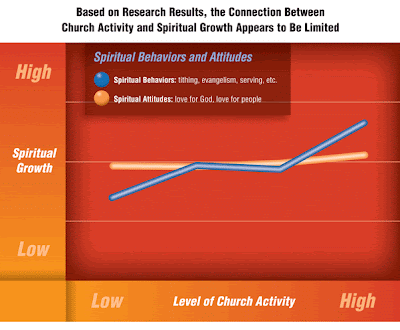
The first finding is that levels of participation in church activities didn't predict measures of spiritual growth. As shown in this graph, the relationship between church activity and spiritual growth appears modest at best.


These findings seem to have hit the leadership of Willow really hard. From the Christianity Today blog,

"Having spent thirty years creating and promoting a multi-million dollar organization driven by programs and measuring participation, and convincing other church leaders to do the same, you can see why Hybels called this research “the wake up call” of his life.
Hybels confesses:

'We made a mistake. What we should have done when people crossed the line of faith and become Christians, we should have started telling people and teaching people that they have to take responsibility to become ‘self feeders.’ We should have gotten people, taught people, how to read their bible between service, how to do the spiritual practices much more aggressively on their own.'"

Critics of Willow have seized upon this admission to term the Willow as deeply flawed.

Is the Willow Creek actually flawed? Maybe, maybe not, but we can't tell from these data for several reasons.

1) How steep a line? As per the chart printed above, both spiritual behaviors increase somewhat with church activities while spiritual attitudes don’t really. The fact that increased church activity correlates with moderate growth is a good sign for Willow. Maybe it’s not as steep a line as they expected, but it’s still going up. They found a much steeper line using a spiritual continuum to predict spiritual growth, but as I posted previously, this may not be a particularly interesting finding. It could be that this is as big effect as can be realistically expected, which leads me to the second point.

2) Compared to what? To judge the effectiveness of any program, you need to compare it to something. For example, if we give a pill to people with some disease, and 25% of the pass away, does the pill work? The answer: We don’t know, and we have to ask what would have happened if they didn’t take the pill. There are several useful comparisons for a study such as Reveal. A) What would have happened to the people if they had not attended church activities? B) What would have happened if they had attended church activities elsewhere? C) What would have happened if they had attended a different level of church activities? The Reveal study ignores the first two comparisons and uses cross-sectional data to approximate the third one. This raises another issue…

3) Contamination. People talk to each other, they learn from each other. In a religious community such as Willow Creek, what is taught to one group of people affects others as well. As such, the impact of programs on high-activity people will probably be spread to low-activity people as well. This effect on low-activity people could change their behavior to make it more similar to the high-activity people, giving the false impression that the activities don’t actually work.

In reality, the ideas being tested here operate at the church-wide level, i.e., is Willow Creek effective as a church? To fully test this question, in turn, requires church level data. For example, find 100 churches, 50 that subscribe to the Willow Creek and 50 that don’t. How are they different? How are they the same? (Ideally you would randomly assign which churches get the Willow Creek but this gets difficult).

4) Activity and maturity. Another interpretation of these data goes as follows. Maybe the individuals who have recently started attending church, especially if they are new Christians, are also the most active in its activities. With time they grow spiritually, but they also settle down into a routine involving fewer activities. This would mask the correlation between church activity and spiritual growth, even if church activities were effective.

It appears that the Reveal Study is over-interpreting the data. The big changes apparently in place at Willow as the result of Reveal may in fact not be warranted. In short, they may be fixing something that isn’t broken.

Here’s an analogy. If someone feels a lump under their arm, they would be rightly concerned about the possibility of cancer. What they should not do, however, is immediately start full-scale cancer treatment such as chemotherapy. What they should do is get a better test, such as a biopsy, to find out if the lump is cancerous and then decide what to do—the lump may be something else.

The findings of the Reveal Study perhaps suggest problems with the Willow , but they may not. They are inherently limited by the cross-sectional design and other features of the study. A more careful look using a more powerful survey design is warranted before an institution as successful as Willow makes serious changes.

Next: Overinterpreting the data?

To start the series

To read the final summary

The problem of porn

Father Lou DelFra writing about pornography highlights some of its negative consequences for college students (and anyone for that matter). He makes a very interesting point:

"Perhaps the most pernicious consequence that students have struggled with is that, over time, repeated pornography use threatens to turn sexuality into an enemy. Students who struggle with pornography frequently talk about their sexuality primarily as something they need to overcome. In fact, it is the use of pornography they are so desperate to overcome, but often this slips into a general adversarial relationship with one's entire sexuality. This is squarely at odds with the life - including the sexual life - that God, who gifted us with our sexuality, intends for us. We are not created to be enemies of the gifts which God has planted deep within us."

Thanks Susie for the link

Tuesday, November 20, 2007

Church Surveys: Willow Creek's Reveal Study, VI

The problem of maximizing predictiveness
(Post 6 in an 11-part series)

The big message in the Reveal Study is that there is a spiritual continuum that predicts spiritual growth. As discussed in previous posts, the spiritual continuum is a four-stage scale of self-defined relationship with Christ, and spiritual growth is various behaviors and attitudes such as tithing, reading the Bible, praying, worshiping.

To make it easier to understand, I drew a picture. As shown below, the Reveal Study assumes the causal #1. The more you define yourself as close to Christ, the more you do Christian things.

The problem with this causal is that several other, equally viable ones exist. Maybe doing Christian things, like reading the Bible, make you feel closer to Christ (i.e., 2). Or, maybe one's self-defined relationship with Christ and one's spiritual practices are mutually interdependent (Model 3).

The that I find most compelling is #4. Various factors "X" affect both self-perceived relationship with Christ as well as spiritual practices. Obviously, from an applied perspective, churches should be looking for those "X"s that increase both.

It's not clear to me that separating "relationship with Christ (i.e., spiritual continuum) and spiritual growth gives us any particular insight, for I think they should be clumped together as outcome measures.

***** Warning: Somewhat technical language below. You can stop reading here and still get the main point of this post *****

The authors support the validity of their continuum -> growth by emphasizing its high predictive power. "Our research experts told us this was one of the most highly predictive s that they had seen (p. 36, emphasis theirs)." Predictive here means that levels of the "spiritual growth" systematically vary by levels of the spiritual continuum. As shown in various tables, the Reveal Study documents that people with higher scores on the continuum also score higher on measures of spiritual growth.

It's not that this statement is inaccurate, rather it's uninteresting.

If you have two measures of about the same thing, well of course they will be highly correlated and thus predictive of each other. Here are some everyday examples of this:

* What's a strong predictor of whether people smoke cigarettes today? If they smoked cigarettes yesterday.

* What's a strong predictor of running a mile fast? Being able to run two miles fast.

* What's a strong predictor of having an in-depth knowledge of the book of John? Knowing the books of Luke well.

Suppose that a church hired a consultant to help it increase the size of its congregation. The consultant came back saying that they the best predictor of church attendance in any given church is the number of cars in the parking lot during services, and so the church should focus on increasing them. My guess is that the church wouldn't necessarily find this help--it's accurate, but not very interesting.

They key in research is to examine the empirical connectedness (i.e., correlation) between variables that are somewhat different, that have an interesting and meaningful connection, if it exists. It's not clear to me that the Reveal study has done this in their emphasis on a spiritual continuum.

Next: Is the Willow model flawed?

To start the series

To read the final summary

Monday, November 19, 2007

Church Surveys: Willow Creek's Reveal Study, V

Measurement Issues
(Post 5 in an 11-part series)

The big take-home message of the Reveal Study, according to its authors, is that church involvement doesn't predict spiritual growth but there is a spiritual continuum that does.

I'll write about the church involvement aspect of this statement in a later post, but here I want to focus on the spiritual continuum. This post discusses its measurement, and the next post in the series addresses causal issues.

From how the authors describe it, a spiritual continuum is a Guttman scale measuring self-defined relationship with Christ. It has four stages:

1) Exploring Christianity. "I believe in God, but I'm not sure about Christ. My faith is not a significant part of my life."

2) Growing in Christ. "I believe in Jesus, and I'm working on what it means to get to know Him."

3) Close to Christ. "I feel really close to Christ and depend on him daily for guidance."

4) Christ-Centered. "God is all that I need in my life. He is enough. Everything I do is a reflection of him."

If I understand it correctly, one can be in one category only, higher scores represent being further along the spiritual continuum, and people in higher stages are assumed to have passed through the lower stages.

Here are some problems with this measure:

* Sequential? It's not clear that these represent a linear (or at least sequential) trajectory of getting closer to Christ. For example, #3 and #4 both seem to represent mature Christian faith.

* Multiple categories. Some people would place themselves into multiple categories. In reading this, I am squarely in #2 and #3. I believe in Christ, feel close to him, am working to get to know him better, and depend on him daily for guidance.

* Mixed message. The #4 level is awkward for me because it implies a perfection that I'll certainly never experience... Is *everything* I do a reflection of Him? I certainly hope not (at least for His name). In fact, I would probably be suspicious of anyone who would agree with this sta

Now, it sounds like I'm being nit-picky about measurement, and, who knows, maybe I am. However, the authors put so much weight on this measure--suggesting that it be a (the?) primary principle of church growth, that it's worth reflecting on its quality.

These types of scales aren't used a lot any more in sociology, and for pretty good reasons. Some of the problems suggested above are typical of them.

I'm not sure that the idea of a four-stage continuum--as conceptualized here--maps on to the reality of Christian life.

Birch & berries (pic)

Sunday, November 18, 2007

When clergy go bad

It's my impression that most religious people--especially clergy--try really hard to do the right thing, but occasionally they lapse and just act plain stupid. Here's a story by Ben Dubow about a meeting he attended in which clergy went bad...

A Surreal Experience Today

By: Ben Dubow

I was in a surreal meeting today.

About monthly a group of clergy and ministers who have ministries on campus get together. The meeting is actually coordinated by the UCONN Dean of Students Office and almost always run by someone from their office. Generally, the meetings range between interesting, fun, a bit repetitive, interesting, etc. It is a nice way to build trust and relationships between the university and us as well as amongst each other.

Today's meeting was truly strange.

The person who normally leads it wasn't there so we were left leaderless and without an agenda. This is always potentially dangerous.

One pastor from one of the churches said they had an issue to raise. It turns out that they were (still) very upset about the signs and fliers we hung around campus (and on Facebook and in the Dining Halls) this August-September. I've posted about these fliers before. We did a series of eight of them. They had catchy lines like "With faith, hope, and love, Church Sucks!" and "On behalf of Christians everywhere We're Sorry for being so judgmental." You get the idea.

They were (hopefully) provocative and generated conversations and connected with people who have given up on institutional religion, but not on God. In fact, they are the most successful outreach of that type that we have ever done. They resonated with people and really connected. I am big believer in addressing the tension and naming the elephant in the room. That is what these fliers were designed to do.

Anyway, this one pastor was very upset. I apologized if he was offended and explained our intention was never to offend. He said he didn't want an apology but wanted to essentially tell us that we weren't allowed to do things like this. He was getting pretty worked up about it and pretty indignant. For the record, others in the room defended the posters. But this guy was pretty worked up.

Finally, the director of the Jewish center on campus spoke up and tried to bring some reason (and closure to the discussion). She then said she had an issue to raise and that she had written a statement out because it was so hard to talk about.

She then read her statement about how offended and hurt she and her staff and students were about the anti-semitic speakers that one of the churches had hosted the night before. (Ironically, this church was the same one that just slammed me for using the word "sucks"--which by the way is not as harsh as what Martin Luther's words when he said "the church is a whore, but she is my mother."--but I digress).

The speakers were pro-Palestinian and anti-Zionist. Both speakers are well-known in the Jewish community and predictably filled their message with slams against Israel, Zionists, the Israeli Defense Force (IDF), etc. One of them even compared the Jewish Star of David to the swastika. Crazy stuff!

Here is the description of the speakers from the churches bulletin:

"What is really going on in Palestine and what is the US role: eyewitness accounts." Dr. Mazin Qumsiyeh and Stanley Heller, founder of the Ct-based Middle East Crisis Committee, report on their 2007 trip to Palestine and examine the US role there. Both men have traveled to the Middle East many times.


Stanley Heller is a school teacher in West Haven, CT. As a Jewish activist for human rights since 1982, he believes each of us can make a difference. He is founder and chair of the Middle East Crisis Committee. He is the producer of a weekly show: The Struggle Video Network. (http://thestruggle.org).

Mazin Qumsiyeh, (UConn ’82) PhD is a Palestinian Christian and US citizen. He was born in Beit Shour, near Bethlehem, home of his ancestors. He is a medical geneticist and has served on the faculties of Duke and Yale Universities. He is on the Steering/Executive Committees of a number of organizations including the Wheels of Justice, US Campaign to End the Occupation, the Palestinian American Congress, Middle East Genetics Association, and AcademicsForJustice.org. His third and latest book is titled "Sharing the Land of Canaan: Human Rights and the Israeli/Palestinian Struggle" in which he explains non-violent strategies to achieve peace based on human rights and justice. Web http://qumsiyeh.org.

Here is an example of the kind of rhetoric being used, from Qumsiyeh (from his website):

"The horrors of what happened in Europe as a result of 19th century nationalism fed the ethnocentric nationalism known as Zionism, and was used to justify the ethnic cleansing and destruction of Palestinian society. It is now destabilizing Western Asia and encouraging other narrow chauvinistic ideologies..." [SOURCE]

[Here is an interesting article about Qumsiyeh to put things in context. Also, most of the organizations these folks are affiliated with are on the list of known anti-semitic groups by the Anti-Defamation League.]

Anyway, it sounds like the event was pretty offensive. As the woman from the Jewish Center pointed out, there is a fine line between critiquing Israel and the anti-Zionism, Anti-Semitic rhetoric that had been spewed the night before. (For the record, I was not at the talk and so do not know what was said. I do know from experience that this particular church has brought in other anti-Israel, pro-Palestinian speakers, some of which have been peaceful and fine others of which were offensive and also anti-semitic). Apparently, one representative from the Jewish Center spoke to the senior pastor at the church and was pretty much dismissed. The woman asked "I thought we were spiritual partners on this campus" to which she was told "no... you are not. We don't see anyone as spiritual partners on this campus..." (Nice!)

To say the least, this new conversation shifted the attention off of our signs---which I was happy about.

At this point things got a little crazy. The two representatives from the Muslim Student Association started defending the speaker and things got very heated and ugly. It is amazing to me how quickly anti-Israel politics becomes blatant anti-Semitism.

From there, both the Muslims and the representatives from this church started talking about how the truth was being hidden by the US media. They kept talking about the media.

This was disturbing to me because historically language like that is very clear code. It is code for things like "the Jews control the media" etc, and is deeply rooted in this country's long history of anti-semitism---often spurned on by churches. Here is an example of the rhetoric often heard:

"These are the facts of Jewish media control in America. Anyone willing to spend several hours in a large library can verify their accuracy. I hope that these facts are disturbing to you, to say the least. Should any minority be allowed to wield such awesome power? Certainly, not and allowing a people with beliefs such as expressed in the Talmud, to determine what we get to read or watch in effect gives this small minority the power to mold our minds to suit their own Talmudic interests, interests which as we have demonstrated are diametrically opposed to the interests of our people."

"By permitting the Jews to control our news and entertainment media, we are doing more than merely giving them a decisive influence on our political system and virtual control of our government; we also are giving them control of the minds and souls of our children, whose attitudes and ideas are shaped more by Jewish television and Jewish films than by their parents, their schools, or any other influence." [SOURCE]

And here is another one:
""However, where the discussion threatens to touch upon issues considered 'sensitive' to the judaized establishment which controls TV and radio, it is carefully stage-managed so that 'dangerous' viewpoints are excluded. s particularly noticeable where discussion concerns matters of the Jewish State of Israel and its not so very glorious aspects, when relating to doubts concerning the alleged mass-slaughter of Jews during WWII and when some one tries to discuss the power wielded by the Jewish minority." [SOURCE]

I was offended as a a Christian. I was also offended as a Jewish person who's grandparents survived the Holocaust (though most of the family perished).

It was a pretty unbelievable scene to watch.

It makes you realize how complicated these issues are, how far we still need to come--and why so many people have given up on the church.

One of our fliers some of the churches found offensive was the one apologizing on behalf of Christians for the long history bigotry, discrimination, sexism, racism, anti-semitism, etc.

I'm surprised anyone would try and defend those parts of our history or pretend like confession isn't needed.

I am passionately in love with the Church (universal!) and believe that the church is the hope of the world, the Bride of Christ! I have given my life to the cause of the local church--and do so without apology or regret.

But the Church is flawed and has failed in its mission over and over again--in both big ways and small. The Crusades... the Spanish Inquisition... slavery... silence during the Holocaust... just to name a few.

We must repent. We must own our sin. We must seek forgiveness and reconciliation.

If those outside the church will ever take us seriously, we must own the sins of previous generations of Christians.

I am shocked sometimes at how little progress has been made.

And I am reminded by WE NEED A SECOND CHANCE, why we must say that WE'RE SORRY, and why WITHOUT FAITH, HOPE & LOVE church sucks!