Wednesday, November 21, 2007

Church Surveys: Willow Creek's Reveal Study, VII

Is the Willow Creek flawed?
(Post 7 in an 11-post series)

The big story to come out of Willow Creek's Reveal Study is that the seeker-sensitive ministry made famous by Willow is supposedly flawed and ineffective. This is based on two findings, the first of which I’ll post on today:

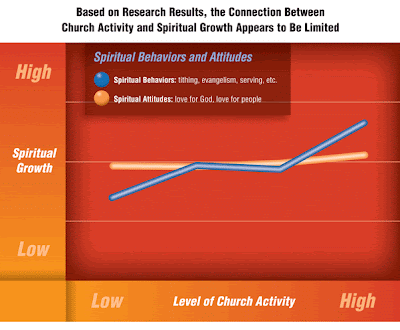
The first finding is that levels of participation in church activities didn't predict measures of spiritual growth. As shown in this graph, the relationship between church activity and spiritual growth appears modest at best.

These findings seem to have hit the leadership of Willow really hard. From the Christianity Today blog,

"Having spent thirty years creating and promoting a multi-million dollar organization driven by programs and measuring participation, and convincing other church leaders to do the same, you can see why Hybels called this research “the wake up call” of his life.
Hybels confesses:

'We made a mistake. What we should have done when people crossed the line of faith and become Christians, we should have started telling people and teaching people that they have to take responsibility to become ‘self feeders.’ We should have gotten people, taught people, how to read their bible between service, how to do the spiritual practices much more aggressively on their own.'"

Critics of Willow have seized upon this admission to term the Willow as deeply flawed.

Is the Willow Creek actually flawed? Maybe, maybe not, but we can't tell from these data for several reasons.

1) How steep a line? As per the chart printed above, both spiritual behaviors increase somewhat with church activities while spiritual attitudes don’t really. The fact that increased church activity correlates with moderate growth is a good sign for Willow. Maybe it’s not as steep a line as they expected, but it’s still going up. They found a much steeper line using a spiritual continuum to predict spiritual growth, but as I posted previously, this may not be a particularly interesting finding. It could be that this is as big effect as can be realistically expected, which leads me to the second point.

2) Compared to what? To judge the effectiveness of any program, you need to compare it to something. For example, if we give a pill to people with some disease, and 25% of the pass away, does the pill work? The answer: We don’t know, and we have to ask what would have happened if they didn’t take the pill. There are several useful comparisons for a study such as Reveal. A) What would have happened to the people if they had not attended church activities? B) What would have happened if they had attended church activities elsewhere? C) What would have happened if they had attended a different level of church activities? The Reveal study ignores the first two comparisons and uses cross-sectional data to approximate the third one. This raises another issue…

3) Contamination. People talk to each other, they learn from each other. In a religious community such as Willow Creek, what is taught to one group of people affects others as well. As such, the impact of programs on high-activity people will probably be spread to low-activity people as well. This effect on low-activity people could change their behavior to make it more similar to the high-activity people, giving the false impression that the activities don’t actually work.

In reality, the ideas being tested here operate at the church-wide level, i.e., is Willow Creek effective as a church? To fully test this question, in turn, requires church level data. For example, find 100 churches, 50 that subscribe to the Willow Creek and 50 that don’t. How are they different? How are they the same? (Ideally you would randomly assign which churches get the Willow Creek but this gets difficult).

4) Activity and maturity. Another interpretation of these data goes as follows. Maybe the individuals who have recently started attending church, especially if they are new Christians, are also the most active in its activities. With time they grow spiritually, but they also settle down into a routine involving fewer activities. This would mask the correlation between church activity and spiritual growth, even if church activities were effective.

It appears that the Reveal Study is over-interpreting the data. The big changes apparently in place at Willow as the result of Reveal may in fact not be warranted. In short, they may be fixing something that isn’t broken.

Here’s an analogy. If someone feels a lump under their arm, they would be rightly concerned about the possibility of cancer. What they should not do, however, is immediately start full-scale cancer treatment such as chemotherapy. What they should do is get a better test, such as a biopsy, to find out if the lump is cancerous and then decide what to do—the lump may be something else.

The findings of the Reveal Study perhaps suggest problems with the Willow , but they may not. They are inherently limited by the cross-sectional design and other features of the study. A more careful look using a more powerful survey design is warranted before an institution as successful as Willow makes serious changes.

Next: Overinterpreting the data?

To start the series

To read the final summary

The problem of porn

Father Lou DelFra writing about pornography highlights some of its negative consequences for college students (and anyone for that matter). He makes a very interesting point:

"Perhaps the most pernicious consequence that students have struggled with is that, over time, repeated pornography use threatens to turn sexuality into an enemy. Students who struggle with pornography frequently talk about their sexuality primarily as something they need to overcome. In fact, it is the use of pornography they are so desperate to overcome, but often this slips into a general adversarial relationship with one's entire sexuality. This is squarely at odds with the life - including the sexual life - that God, who gifted us with our sexuality, intends for us. We are not created to be enemies of the gifts which God has planted deep within us."

Thanks Susie for the link

Tuesday, November 20, 2007

Church Surveys: Willow Creek's Reveal Study, VI

The problem of maximizing predictiveness
(Post 6 in an 11-part series)

The big message in the Reveal Study is that there is a spiritual continuum that predicts spiritual growth. As discussed in previous posts, the spiritual continuum is a four-stage scale of self-defined relationship with Christ, and spiritual growth is various behaviors and attitudes such as tithing, reading the Bible, praying, worshiping.

To make it easier to understand, I drew a picture. As shown below, the Reveal Study assumes the causal #1. The more you define yourself as close to Christ, the more you do Christian things.

The problem with this causal is that several other, equally viable ones exist. Maybe doing Christian things, like reading the Bible, make you feel closer to Christ (i.e., 2). Or, maybe one's self-defined relationship with Christ and one's spiritual practices are mutually interdependent (Model 3).

The that I find most compelling is #4. Various factors "X" affect both self-perceived relationship with Christ as well as spiritual practices. Obviously, from an applied perspective, churches should be looking for those "X"s that increase both.

It's not clear to me that separating "relationship with Christ (i.e., spiritual continuum) and spiritual growth gives us any particular insight, for I think they should be clumped together as outcome measures.

***** Warning: Somewhat technical language below. You can stop reading here and still get the main point of this post *****

The authors support the validity of their continuum -> growth by emphasizing its high predictive power. "Our research experts told us this was one of the most highly predictive s that they had seen (p. 36, emphasis theirs)." Predictive here means that levels of the "spiritual growth" systematically vary by levels of the spiritual continuum. As shown in various tables, the Reveal Study documents that people with higher scores on the continuum also score higher on measures of spiritual growth.

It's not that this statement is inaccurate, rather it's uninteresting.

If you have two measures of about the same thing, well of course they will be highly correlated and thus predictive of each other. Here are some everyday examples of this:

* What's a strong predictor of whether people smoke cigarettes today? If they smoked cigarettes yesterday.

* What's a strong predictor of running a mile fast? Being able to run two miles fast.

* What's a strong predictor of having an in-depth knowledge of the book of John? Knowing the books of Luke well.

Suppose that a church hired a consultant to help it increase the size of its congregation. The consultant came back saying that they the best predictor of church attendance in any given church is the number of cars in the parking lot during services, and so the church should focus on increasing them. My guess is that the church wouldn't necessarily find this help--it's accurate, but not very interesting.

They key in research is to examine the empirical connectedness (i.e., correlation) between variables that are somewhat different, that have an interesting and meaningful connection, if it exists. It's not clear to me that the Reveal study has done this in their emphasis on a spiritual continuum.

Next: Is the Willow model flawed?

To start the series

To read the final summary

Monday, November 19, 2007

Church Surveys: Willow Creek's Reveal Study, V

Measurement Issues
(Post 5 in an 11-part series)

The big take-home message of the Reveal Study, according to its authors, is that church involvement doesn't predict spiritual growth but there is a spiritual continuum that does.

I'll write about the church involvement aspect of this statement in a later post, but here I want to focus on the spiritual continuum. This post discusses its measurement, and the next post in the series addresses causal issues.

From how the authors describe it, a spiritual continuum is a Guttman scale measuring self-defined relationship with Christ. It has four stages:

1) Exploring Christianity. "I believe in God, but I'm not sure about Christ. My faith is not a significant part of my life."

2) Growing in Christ. "I believe in Jesus, and I'm working on what it means to get to know Him."

3) Close to Christ. "I feel really close to Christ and depend on him daily for guidance."

4) Christ-Centered. "God is all that I need in my life. He is enough. Everything I do is a reflection of him."

If I understand it correctly, one can be in one category only, higher scores represent being further along the spiritual continuum, and people in higher stages are assumed to have passed through the lower stages.

Here are some problems with this measure:

* Sequential? It's not clear that these represent a linear (or at least sequential) trajectory of getting closer to Christ. For example, #3 and #4 both seem to represent mature Christian faith.

* Multiple categories. Some people would place themselves into multiple categories. In reading this, I am squarely in #2 and #3. I believe in Christ, feel close to him, am working to get to know him better, and depend on him daily for guidance.

* Mixed message. The #4 level is awkward for me because it implies a perfection that I'll certainly never experience... Is *everything* I do a reflection of Him? I certainly hope not (at least for His name). In fact, I would probably be suspicious of anyone who would agree with this sta

Now, it sounds like I'm being nit-picky about measurement, and, who knows, maybe I am. However, the authors put so much weight on this measure--suggesting that it be a (the?) primary principle of church growth, that it's worth reflecting on its quality.

These types of scales aren't used a lot any more in sociology, and for pretty good reasons. Some of the problems suggested above are typical of them.

I'm not sure that the idea of a four-stage continuum--as conceptualized here--maps on to the reality of Christian life.

Birch & berries (pic)

Sunday, November 18, 2007

When clergy go bad

It's my impression that most religious people--especially clergy--try really hard to do the right thing, but occasionally they lapse and just act plain stupid. Here's a story by Ben Dubow about a meeting he attended in which clergy went bad...

A Surreal Experience Today

By: Ben Dubow

I was in a surreal meeting today.

About monthly a group of clergy and ministers who have ministries on campus get together. The meeting is actually coordinated by the UCONN Dean of Students Office and almost always run by someone from their office. Generally, the meetings range between interesting, fun, a bit repetitive, interesting, etc. It is a nice way to build trust and relationships between the university and us as well as amongst each other.

Today's meeting was truly strange.

The person who normally leads it wasn't there so we were left leaderless and without an agenda. This is always potentially dangerous.

One pastor from one of the churches said they had an issue to raise. It turns out that they were (still) very upset about the signs and fliers we hung around campus (and on Facebook and in the Dining Halls) this August-September. I've posted about these fliers before. We did a series of eight of them. They had catchy lines like "With faith, hope, and love, Church Sucks!" and "On behalf of Christians everywhere We're Sorry for being so judgmental." You get the idea.

They were (hopefully) provocative and generated conversations and connected with people who have given up on institutional religion, but not on God. In fact, they are the most successful outreach of that type that we have ever done. They resonated with people and really connected. I am big believer in addressing the tension and naming the elephant in the room. That is what these fliers were designed to do.

Anyway, this one pastor was very upset. I apologized if he was offended and explained our intention was never to offend. He said he didn't want an apology but wanted to essentially tell us that we weren't allowed to do things like this. He was getting pretty worked up about it and pretty indignant. For the record, others in the room defended the posters. But this guy was pretty worked up.

Finally, the director of the Jewish center on campus spoke up and tried to bring some reason (and closure to the discussion). She then said she had an issue to raise and that she had written a statement out because it was so hard to talk about.

She then read her statement about how offended and hurt she and her staff and students were about the anti-semitic speakers that one of the churches had hosted the night before. (Ironically, this church was the same one that just slammed me for using the word "sucks"--which by the way is not as harsh as what Martin Luther's words when he said "the church is a whore, but she is my mother."--but I digress).

The speakers were pro-Palestinian and anti-Zionist. Both speakers are well-known in the Jewish community and predictably filled their message with slams against Israel, Zionists, the Israeli Defense Force (IDF), etc. One of them even compared the Jewish Star of David to the swastika. Crazy stuff!

Here is the description of the speakers from the churches bulletin:

"What is really going on in Palestine and what is the US role: eyewitness accounts." Dr. Mazin Qumsiyeh and Stanley Heller, founder of the Ct-based Middle East Crisis Committee, report on their 2007 trip to Palestine and examine the US role there. Both men have traveled to the Middle East many times.


Stanley Heller is a school teacher in West Haven, CT. As a Jewish activist for human rights since 1982, he believes each of us can make a difference. He is founder and chair of the Middle East Crisis Committee. He is the producer of a weekly show: The Struggle Video Network. (http://thestruggle.org).

Mazin Qumsiyeh, (UConn ’82) PhD is a Palestinian Christian and US citizen. He was born in Beit Shour, near Bethlehem, home of his ancestors. He is a medical geneticist and has served on the faculties of Duke and Yale Universities. He is on the Steering/Executive Committees of a number of organizations including the Wheels of Justice, US Campaign to End the Occupation, the Palestinian American Congress, Middle East Genetics Association, and AcademicsForJustice.org. His third and latest book is titled "Sharing the Land of Canaan: Human Rights and the Israeli/Palestinian Struggle" in which he explains non-violent strategies to achieve peace based on human rights and justice. Web http://qumsiyeh.org.

Here is an example of the kind of rhetoric being used, from Qumsiyeh (from his website):

"The horrors of what happened in Europe as a result of 19th century nationalism fed the ethnocentric nationalism known as Zionism, and was used to justify the ethnic cleansing and destruction of Palestinian society. It is now destabilizing Western Asia and encouraging other narrow chauvinistic ideologies..." [SOURCE]

[Here is an interesting article about Qumsiyeh to put things in context. Also, most of the organizations these folks are affiliated with are on the list of known anti-semitic groups by the Anti-Defamation League.]

Anyway, it sounds like the event was pretty offensive. As the woman from the Jewish Center pointed out, there is a fine line between critiquing Israel and the anti-Zionism, Anti-Semitic rhetoric that had been spewed the night before. (For the record, I was not at the talk and so do not know what was said. I do know from experience that this particular church has brought in other anti-Israel, pro-Palestinian speakers, some of which have been peaceful and fine others of which were offensive and also anti-semitic). Apparently, one representative from the Jewish Center spoke to the senior pastor at the church and was pretty much dismissed. The woman asked "I thought we were spiritual partners on this campus" to which she was told "no... you are not. We don't see anyone as spiritual partners on this campus..." (Nice!)

To say the least, this new conversation shifted the attention off of our signs---which I was happy about.

At this point things got a little crazy. The two representatives from the Muslim Student Association started defending the speaker and things got very heated and ugly. It is amazing to me how quickly anti-Israel politics becomes blatant anti-Semitism.

From there, both the Muslims and the representatives from this church started talking about how the truth was being hidden by the US media. They kept talking about the media.

This was disturbing to me because historically language like that is very clear code. It is code for things like "the Jews control the media" etc, and is deeply rooted in this country's long history of anti-semitism---often spurned on by churches. Here is an example of the rhetoric often heard:

"These are the facts of Jewish media control in America. Anyone willing to spend several hours in a large library can verify their accuracy. I hope that these facts are disturbing to you, to say the least. Should any minority be allowed to wield such awesome power? Certainly, not and allowing a people with beliefs such as expressed in the Talmud, to determine what we get to read or watch in effect gives this small minority the power to mold our minds to suit their own Talmudic interests, interests which as we have demonstrated are diametrically opposed to the interests of our people."

"By permitting the Jews to control our news and entertainment media, we are doing more than merely giving them a decisive influence on our political system and virtual control of our government; we also are giving them control of the minds and souls of our children, whose attitudes and ideas are shaped more by Jewish television and Jewish films than by their parents, their schools, or any other influence." [SOURCE]

And here is another one:
""However, where the discussion threatens to touch upon issues considered 'sensitive' to the judaized establishment which controls TV and radio, it is carefully stage-managed so that 'dangerous' viewpoints are excluded. s particularly noticeable where discussion concerns matters of the Jewish State of Israel and its not so very glorious aspects, when relating to doubts concerning the alleged mass-slaughter of Jews during WWII and when some one tries to discuss the power wielded by the Jewish minority." [SOURCE]

I was offended as a a Christian. I was also offended as a Jewish person who's grandparents survived the Holocaust (though most of the family perished).

It was a pretty unbelievable scene to watch.

It makes you realize how complicated these issues are, how far we still need to come--and why so many people have given up on the church.

One of our fliers some of the churches found offensive was the one apologizing on behalf of Christians for the long history bigotry, discrimination, sexism, racism, anti-semitism, etc.

I'm surprised anyone would try and defend those parts of our history or pretend like confession isn't needed.

I am passionately in love with the Church (universal!) and believe that the church is the hope of the world, the Bride of Christ! I have given my life to the cause of the local church--and do so without apology or regret.

But the Church is flawed and has failed in its mission over and over again--in both big ways and small. The Crusades... the Spanish Inquisition... slavery... silence during the Holocaust... just to name a few.

We must repent. We must own our sin. We must seek forgiveness and reconciliation.

If those outside the church will ever take us seriously, we must own the sins of previous generations of Christians.

I am shocked sometimes at how little progress has been made.

And I am reminded by WE NEED A SECOND CHANCE, why we must say that WE'RE SORRY, and why WITHOUT FAITH, HOPE & LOVE church sucks!

Saturday, November 17, 2007

Forsythia & barn window (pic)

Here's a picture I took a couple of years ago. It's a cold, blustery day today, so I thought it would be fun to remember what spring looks like.

Thursday, November 15, 2007

Church Surveys: Willow Creek's Reveal Study, IV

Dimensions of Religiosity
(Post 4 in an 11-part series)

In terms of what can be improved with the Reveal Study, I'm starting with what is ultimately an unfair question--unfair because I certainly don't know the answer, and they may not be a clear answer.

What should be the outcome variable of church surveys? That is, what's the end toward which all means aim to increase?

The Reveal Study uses individual "spiritual behaviors"--such as prayer, tithing, evangelism, and serving as well as "spiritual attitudes"--love for God and love for people. These are reasonable, for many Christians would argue against their importance, but there are other reasonable measures as well.

Sociologists have spent a lot of time trying to figure out which dimensions underly religiousness, and they have come up with a variety of answers. An early, classic statement about this comes from the work of Rodney Stark and Charles Glock who identified 8 dimensions of "religiosity." They are:

1) Experiential--feelings of having communed with God, having received revelation or direct experience with God.

2) Devotional--private devotion, private prayer.

3) Ritualistic--participation in group worship services and other activities

4) Belief--the extent to which the person believes in the theological beliefs of the group

5) Knowledge--the extent to which the person knows the believes and doctrine of the group.

6) Consequential--how people's lives--their attitudes and behaviors, are changed by their religious involvement.

7) Communal--one's social integration into the religious group, how many friends they have who are fellow believers.

8) Particularism--the degree to which the person believes that their faith is the true path to salvation.

The Reveal Study emphasizes the consequential dimension of religion--various attitudes and behaviors that should be changed by religion. (They are not entirely clear on how they constructed their outcome measure, so there may be more than that). They use the experiential dimension as a predictor (or independent variable) which they call a spiritual continuum.

This leaves significant aspects of the Christian walk not covered by the outcome measures employed by Reveal. Even with the consequential dimension, as Jerry pointed out in a comment, there are other expected consequences of Christianity, such as character traits, as described by the fruit of the spirit.

Where does this leave us? The limited range of outcomes in Reveal does not invalidate it findings, but rather examining a broader range of outcomes might produce a richer, and ultimately different, story.

What do you think? What should be the main outcomes measured in church surveys? This is a fascinating question because it's both theological and methodological.

Wednesday, November 14, 2007

Church Surveys: Willow Creek's Reveal Study, III

What Reveal Does Well
(Post 3 in an 11-part series)

Let's start with some things that Reveal does well:

First, they are collecting data. There's a lot in the church that can't be done by taking surveys, most important things probably; nonetheless, surveys can offer extremely valuable information for relatively little cost. Frankly, it's beyond me why any church wouldn't routinely survey its members. (I suppose that's why I'm a sociologist and not a pastor ;-).

I have been in countless meetings and discussions that hinged on questions such as "what do people in the church think about this" or "how many people are doing that." These are empirical questions, and they can be answered with some authority with surveys. If we care about them, why not take the time to answer them?

Second, they collected both qualitative and quantitative data. Just because surveys produce numbers we tend to be infatuated with them, but in-person interviews such as they conducted can also be valuable. Combining the two--numbers and words--is powerful for a relatively new area of study such as this one.

Third, they ask some very interesting applied questions. Sociologists and other researchers routinely use great research methods, but the questions we seek to answer can be a little... oh what's the word, dry? At our worst we publish about things that only a few others would care about. Some sociologists are able to break out of this and write about things of more broader relevance (Christian Smith comes to mind), but most of us are just filling up the shelves of university libraries. In contrast, the questions asked by Reveal seem to matter in a more fundamental level--at least for Christians. So I'm pleased to see social science methods being applied here.

Fourth, I think that one of their findings will prove especially valuable for the church--that Christians of different maturity levels need different things from their churches. That is, a church's activities are not one-size-fits-all. At various times in my life, I have attended churches clearly geared for someone other than me, and, gosh, was I bored.

Next: Dimensions of religiosity

To start the series

To read the final summary

.

Walking bush (pic)

A dried bush at sunrise...

Tuesday, November 13, 2007

Church Survey: Willow Creek's Reveal Study, II

A summary of Reveal
(Post 2 in an 11-part series)

Data

The data examined in Reveal come from about 5,000 e-mailed surveys filled out by members of 7 different churches, identified as "geographically and culturally diverse." (The response rate is not given).

The questionnaire covered various questions about the respondents' church-related attitudes, practices, satisfaction, and participation with the church.

Measures

The most important measures cover what Reveal refers to a four step "spiritual continuum."

1) Exploring Christianity. "I believe in God but I'm not sure about Christ. My faith is not a significant part of my life"
2) Growing in Christ. "I believe in Jesus, and I'm working on what it means to get to know him."
3) Close to Christ. "I feel really close to Christ and depend on him daily for guidance."
4) Christ-Centered. "God is all I need in my life. He is enough.

They also measure spiritual growth as spiritual attitudes behaviors (e.g., tithing, evangelism, serving, reading the bible, praying, loving God, loving others). Spiritual growth is used mainly as a dependent or outcome variable (i.e., something to be explained).

Results
The study links these four stages to various attitudes and behaviors. For example, going from steps 1 to 4 increases rates of prayer, reading the Bible, tithing, serving, and evangelism.

They make conclude that:
1) Time spent in church does not predict spiritual growth
2) Progress on the spiritual continuum does predict spiritual growth.
3) The church has most influence on people in the early stages of the continuum. E.g., weekend services are critical for new believers but not for long-time attendees.
4) Personal spiritual practices predict Christ-centered living. (Here they introduce new language without defining it... it reads like a restatement of #2).
5) The churches most active evangelists, volunteers, and donors come from the higher steps of the continuum (this also is ultimately a restatement of #2).
6) One-quarter of the respondents were "spiritually stalled" or "dissatisfied" with the church's role in their spiritual growth.

Conclusion:
Bill Hybels, pastor of Willow Creek, declares the findings painful and revolutionary.

Christianity Today has a nice article about the book, and it details how dramatically it has affected the thinking at Willow Creek, and, by extension, potentially substantial portions of the U.S. evangelical church.

"Speaking at the Leadership Summit, Hybels summarized the findings this way:

Some of the stuff that we have put millions of dollars into thinking it would really help our people grow and develop spiritually, when the data actually came back it wasn’t helping people that much. Other things that we didn’t put that much money into and didn’t put much staff against is stuff our people are crying out for.

Having spent thirty years creating and promoting a multi-million dollar organization driven by programs and measuring participation, and convincing other church leaders to do the same, you can see why Hybels called this research “the wake up call” of his life.

Hybels confesses:

We made a mistake. What we should have done when people crossed the line of faith and become Christians, we should have started telling people and teaching people that they have to take responsibility to become ‘self feeders.’ We should have gotten people, taught people, how to read their bible between service, how to do the spiritual practices much more aggressively on their own.

In other words, spiritual growth doesn’t happen best by becoming dependent on elaborate church programs but through the age old spiritual practices of prayer, bible reading, and relationships. And, ironically, these basic disciplines do not require multi-million dollar facilities and hundreds of staff to manage."

In short: This study is a big deal. As such, it should be considered very carefully.

Next: What works well with the study.

To start the series

To read the final summary

Monday, November 12, 2007

A review of "Reveal: Where are You?" by Greg Hawkins and Cally Parkinson

(Post 1 in an 11-part series)

Willow Creek Church has recently conducted a several years worth of survey research about their church and various others. Their book, Reveal, summarizes the findings of this research and promises that "the answer will transform your church."

Given the importance of Willow Creek in the Evangelical world, and the novelty of this data-driven approach, I am taking the liberty of offering a review of this book. I'm a fan of Willow Creek, in general, and this book has done nothing to dissuade me. It's a useful first step in introducing survey methodology into the church context.

In reviewing it, I will take what is my somewhat standard approach and discuss what I think works well and what I think can be improved. As a sociologist, I'll focus on methodological issues more than church growth issues. I'll also make this into a series of posts so that I can elaborate more fully.

In launching this series, let me point out what may be a difference in cultures. In academia, if you think something is important, you give it your critical attention. If something is of little value, you just ignore it. In the rest of the (saner) world, critical attention means something else, usually less appealing. It's in an academic sense, then, that I review Reveal... to show my appreciation for what they have done and perhaps help people understand it more fully.

Next: I'll summarize Reveal's methodology and findings

Floyd walking home (pic)

Here's a picture of Floyd walking home from a friend's house. Yes, those are the real colors of the trees.

Saturday, November 10, 2007

Friday, November 09, 2007

Breaching Experiments: Grocery Shopping, Ordering Whoppers, and Borat

Every once in awhile sociologists go bad—but for a good purpose. We call it a “breaching experiment.”

There are some things in life that everyone knows are wrong, such as , arson, robbery, etc… (Well, just about everyone. There are a few exceptions who we call psychopaths). Society outlaws these activities and pays people to enforce these laws.

There are a lot of other things, however, that society considers wrong but are not officially illegal (though they can get you into trouble). Defining these wrong things are countless unwritten rules about what we should and shouldn’t do in everyday life, and violating these rules might get us laughed at or punched in the nose. These unwritten rules are social norms, and they guide just about every possible activity a human being can do.

Unwritten rules guide every social situation. For example, let’s take a simple behavior—a student walking into class. What are you supposed to do? Enter somewhat quietly, maybe talk with someone else. Keep a relatively neutral look on your face. Walk to your seat, keeping a mostly even pace, and sit down.

There are a lot of things that you should not do. You shouldn’t run as fast as you can, skip like a little kid on the playground, walk backwards, or crawl (unless you’re begging for something from the professor).

You shouldn’t yell at people across the room, bark like dog, or pretend to be train steaming down the track. You shouldn’t stick your tongue out at the professor, sob loudly, or have a maniacal “I’m an axe killer” grin on your face. If you violate these rules, you’ll probably get laughed at.

At this point you’re probably thinking “duh”—you already know all these rules and you’re beginning to wonder why sociologists get paid to spell out the obvious. (We sometimes wonder the same thing ourselves). The fact that you already know these rules is an important point. Society trains people (via parents and teachers and friends and strangers on the street) to do the “right” thing in every situation so that not long past our toddler days we’re all walking encyclopedias of the rules of every day life. Do you think the rules of hockey are complicated? The laws of quantum mechanics? They are nothing compared to everyday social situations.

Now, let’s have some fun. An easy way to demonstrate the prevalence and power of social norms is to do a “breaching” experiment in which you intentionally break social norms and see how strongly people react. (This methodology was developed by Harold Garfinkel in the 1960s and 70s.)

A classic “breaching” experiment involved shopping. Researchers would go to a grocery store, and then instead of pulling the items off the shelf, they would pull them out of other people’s carts. When other shoppers noticed this behavior, they would expect the researcher to say something like “oh, I thought that was my cart,” but instead the researcher just explained that it was easier to reach the items in the other person’s cart. While grocery stores do not post signs forbidding this behavior, it clearly violated the unwritten rules of shopping and the shoppers reacted with anger.

In another experiment, the researcher would go into McDonalds, step up to the counter, and order a Whopper (the hamburger made by McDonalds’ rival Burger King). The clerk behind the register would explain that it’s McDonalds, and then the researcher would again order a Whopper. At this point the clerk would look around to see if anyone else heard this breach, and they would start trying to figure out what was happening. Maybe the customer was joking? Maybe they were deluded? Either way, it was breaking norms.

Have you seen the movie Borat: Cultural Learnings of America for Make Benefit Glorious Nation of Kazakhstan? In addition to being side-splittingly funny (and rather gross), it is one, long breaching experiment. The character Borat is from Kazakhstan, and he travels around the United States pretending that he doesn’t know our social norms, and he breaks many of them. In one scene he walks the streets of New York City and starts talking to strangers. Some of the strangers get so unnerved that they literally run away from him. Then—as passersby gasp in horror--he squats down in the bushes in front of Trump Tower to go to the bathroom.

What’s the take home message of this line of research? Norms are as much a part of social life as air and water are of physical life—they are everyPublish Postwhere, and we can’t live without them.

In fact, I can’t think of any social behavior that is not guided by norms. Can you? That’s why there will always be room for sociologists and our breaching experiments.

***

Originally posted in Norton's Everydaysociologyblog.com

Photo 1

Photo 2

Photo 3

Thursday, November 08, 2007

An academic question

I was talking to a student during office hours, and I asked her what she was studying. Her answer: Two majors (Anthro and Soci) and two minors (Poly Sci and Philosophy). Now, she's an extreme case, but it seems to be relatively common for UConn students to have multiple majors or multiple minors.

As an undergrad, I only knew one person with a double major, so my impression is that multiple degrees are getting to be more common.

Two questions, then:

Is that your impression?

If so, why the change?

Wednesday, November 07, 2007

Maple leaves (pic)

Our neighbor's maple tree turns deep red for a few weeks this time of year...


The Bible and the Olympics in China

Wow, must be a dangerous book...

Tuesday, November 06, 2007

Open Source Religion


Well, I suppose it was bound to happen. There is now an open-source religion, Yoism.

From wikipedia: it represents "a continuous process of refinement and dialogue among the believers themselves. In comparison to traditional religions - which are considered authoritarian, hierarchical, and change-resistant - they emphasize participation, self-determination, decentralization, and evolution."

From their website, their saints appear to be Albert Einstein, Richard Dawkins, Jon Stewart, Stephen Colbert, and... the Dixie Chicks (?).
I was kind of hoping that there would be something a little more original, thoughtful than what's here.

Thoughts?

Monday, November 05, 2007

Atheists cartoon


I'm not sure that it's entirely accurate, but it's funny.