Tonight's dinner table discussion (while eating a greek dish): Does feta cheese come from the milk of sheep, goats, or chickens.
Wednesday, May 30, 2007


How I learned to stop worrying and love the fear

As I sat at my office this afternoon, enjoying the serene view of summer out my window, what should I hear today but an air raid siren. Of course, what else would you hear in rural Connecticut this time of year?
It turns out that they were testing the air raid sirens to see if even worked and, if so, could they be heard throughout campus? The answer, I can assure you, is "yes" and "yes".
They haven't used these sirens for many, many years, and so I imagine they had to call somebody who retired long ago to even find out where the darn things are.
Why would they care about the sirens? Well, whereas in the 1950s, we feared be bombed by the Russians (and post-Coldwar documents have shown Storrs to be a priority in the communists bombing plans), now we worry about Virginia Tech type shootings. You see, these sirens are to alert people of when (certainly not just "if") such shootings will happen.
A friend who is in campus administration (and still remarkably sensible) told me that after the VT massacre, UConn officials were asked by various parties what they were going to do to prevent such an event here. At the time, there wasn't any obvious solution... students are already prohibited from having guns on campus. I suppose that somebody had to do something, so now we have air raid sirens to listen for.
What better way to deter this type of crime than blaring a loud siren... maybe students who flip out with guns also gain sensitivity to loud noises. "I would start ranting and shoot you all, but... oh, my ears."

Tuesday, May 29, 2007
No parsimony in the classroom
Sometimes I come away from teaching pumped up about teaching college students. So much potential with these young minds.
Other times I'm rather discouraged, and now is one of those times. I just taught the first class of summer school, and as I was lecturing I used a word that produced a few quizzical looks. So, I stopped and explained it, and still... Finally, I asked how many student had known what the word meant? Out of 21 students, only one did, and she's attends a private college (and is just picking up an extra class over the summer).
That esoteric word: parsimony.
Other times I'm rather discouraged, and now is one of those times. I just taught the first class of summer school, and as I was lecturing I used a word that produced a few quizzical looks. So, I stopped and explained it, and still... Finally, I asked how many student had known what the word meant? Out of 21 students, only one did, and she's attends a private college (and is just picking up an extra class over the summer).
That esoteric word: parsimony.
Monday, May 28, 2007
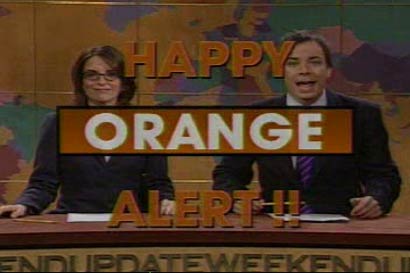
Code orange

When I flew out to SoCal last week, I heard a strange thing over the loudspeakers at the airports. A serious voice announced that the Homeland Security people had put out an orange alert. Now, according to their website, an orange alert means "high" risk of terrorist attack.
Ok...
First off, I'm not a huge fan of flying to begin with, so this extra "you may die" information isn't that helpful.
Second, what am I supposed to do with this knowledge? Why are they telling us it? There are five color alerts (I had to look that up, but I figured at the time that orange wasn't good). Maybe Homeland Security people should give us instructions on how to react to each color. Here are some ideas:
Green: Make all the bomb jokes you want. We'll laugh.
Blue: Glare at fellow passengers.
Yellow: Eat a good meal, it might be your last.
Orange: Run to the nearest airport kiosk and start dumping out water bottles.
Red: Initiate immediate racial and ethnic profiling.
Photo
Friday, May 25, 2007
Christians and pornography
 (Post 6 in a series)
In this series, I am going through various sexual behaviors and examining rates of Christians' participation in them versus those of people of other religions and no religions. Today's topic is pornography.
Before getting to the data, let me point readers to xxxchurch.com. These guys do a *great* job in helping the Church deal with the issue of pornography. They also made an hilarious and interesting documentary about their getting going, called Missionary Positions. (Watch it here).
The General Social Survey asks respondents if they have watched X-rated movies in the previous year. Taking data from the last 20 years, here are rates by religion and attendance to religious services. I define active as attending on about a weekly basis.
37%, No religious affliation
33%, Non-active Black Protestants
33%, Non-Active Catholics
32%, Non-active other religions
28%, Non-active Evangelicals
26%, Jews
25%, Total sample
24%, Non-active Mainline Protestants
20%, Active Black Protestants
15%, Active Catholics
14%, Active in other religions
10%, Active Mainline Protestants
9%, Active Evangelicals
Sample size = 17,711
Thursday, May 24, 2007
Back to respectability
Well, in SoCal, I had several long talks with my brother. In one of them, I told him various things about our lives and family and typical brother stuff.... In return, he said something along the lines of "dude, get a haircut." When even your brother tells you to do it, it's time. So I did: Just about all of it. I went from shoulder length hair to trimmed sides and looking just like everyone else. Sigh... At least I don't have to act respectable.
Wednesday, May 23, 2007
Christians and promuscious sexual behavior
(Post 5 in a series)
In the last several posts, I looked at pretty standard measures of sexual behavior--premarital and extramarital sex. Here I look at a measure that perhaps gets at promiscuity. The General Social Survey asks respondents how many sexual partners they have had in the previous year, and below are the percentage of respondents who reported that they had 3 or more sexual partners. I chose the number three because with two it could be someone getting a divorce and remarrying. Three implies something more.
In the last several posts, I looked at pretty standard measures of sexual behavior--premarital and extramarital sex. Here I look at a measure that perhaps gets at promiscuity. The General Social Survey asks respondents how many sexual partners they have had in the previous year, and below are the percentage of respondents who reported that they had 3 or more sexual partners. I chose the number three because with two it could be someone getting a divorce and remarrying. Three implies something more.
% of respondents with three or more sexual partners in the past year:
13%, No religious affiliation (n=2,369)
12%, Non-active Black Protestants (580)
9%, Non-Active, other religions (740)
9%, Non-Active Catholics (3,166)
8%, Jewish (406)
6%, Non-active Mainline Protestants (2,695)
6%, Active Black Protestants (580)
6%, Non-active Evangelicals (2,795)
3%, Active, other religions (454)
2%, Active Evangelicals (2,361)
2%, Active Catholics (3,166)
1%, Active Mainline Protestants (1,070)
Caveats: I am not controlling for age... maybe it's just that young people sleep around more and young people are also less religious. I'm also not controlling for marriage. Maybe religious people are more likely to be married and married people are less likely to have multiple sexual partners.
Tuesday, May 22, 2007
John Wright, man of action

Here's a picture of my brother launching a couple of days ago. I believe that he was sipping a martini when the call came in from a government official that they needed his help.
BTW, the canyon he's launching over is about 2,000 feet down. Yikes!
John very kindly hosted me to a great time, including daily trips to the hang gliding site, eating at great restaurants, and fun play time with his daughter.
Monday, May 21, 2007
We're #1
U-S-A, U-S-A, U-S-A
I'm doing my part to keep the USA #1! I've been pounding In-N-Out and Mexican food all week. Those bloggers who do push-ups in bowling alleys and who run marathons are holding us back. With effort and concentration, I'm sure we can break through the 1/3 mark... You've got to want it!

Chart
Sunday, May 20, 2007
Religion and infidelity in Kenya
Here's an article sent to me by Ben in Nairobi. (Thanks Ben). It demonstrates how issues of religion and sex vary widely across cultures...
Smitten by the witches of Meru
--------------------------------------------------------------------------------
Last Updated on May 14, 2007, 12:00 am
By Peter Thatiah
Good advice for married men: Next time you lose your national identity card, the first place to look for it is at the local witchdoctor’s den.
Not only are witchdoctors in love with other men’s identity cards but also, it seems it is the latest weapon of combating husbands with roving eyes on the eastern slopes of Mount Kenya.
Armed with wallets stuffed with miraa money, men from this region are some of the most liquid in the country. The season of the second lump payment for tea produce, also known as tea bonus in the area, is even merrier.
Husbands are known to vanish from their homes for weeks after the ‘bonus’ only to reappear after the money has been depleted — never mind that they are hardly ever involved in the tea-picking itself.
This has driven many women to devise drastic ways of taming their wayward husbands.
The recent death of a famed witchcraft master in the Akirang’ondu area of Meru North District has left many men with frayed nerves.
Fame for containing wayward husbands
For the rest of the article:
Smitten by the witches of Meru
--------------------------------------------------------------------------------
Last Updated on May 14, 2007, 12:00 am
By Peter Thatiah
Good advice for married men: Next time you lose your national identity card, the first place to look for it is at the local witchdoctor’s den.
Not only are witchdoctors in love with other men’s identity cards but also, it seems it is the latest weapon of combating husbands with roving eyes on the eastern slopes of Mount Kenya.
Armed with wallets stuffed with miraa money, men from this region are some of the most liquid in the country. The season of the second lump payment for tea produce, also known as tea bonus in the area, is even merrier.
Husbands are known to vanish from their homes for weeks after the ‘bonus’ only to reappear after the money has been depleted — never mind that they are hardly ever involved in the tea-picking itself.
This has driven many women to devise drastic ways of taming their wayward husbands.
The recent death of a famed witchcraft master in the Akirang’ondu area of Meru North District has left many men with frayed nerves.
Fame for containing wayward husbands
For the rest of the article:
Saturday, May 19, 2007
Dispatch from SoCal
Well, somehow I've ended up at an all-inclusive resort... my brother is doing/has everything. We went for a bicycle ride along the coast this morning, and we're eating out most meals. It's been ages since we've gotten to hang out like this, and I'm really enjoying it.
Yesterdays hang gliding was, well, nerve-wracking. The air was really bumpy--like a plane going through turbulence--and it had been six months since I had flown. Still, I launched from 2,200 feet and landed in once piece. I belly-flopped the landing, not very hard, but unfortunately, my brother got it on video.
SoCal moments:
- My brother blogging while I was driving us home yesterday. His laptop has a wireless plug-in or something like that.
- An amazing number of expensive cars... very few 10-year-old Honda station wagons
- Outstanding Mexican food (though we eat it after, not before, flying).
Friday, May 18, 2007
Christians and rates of premarital sex
(Post 4 in a series)
Having looked at extramarital sex in the past few posts, I now turn to its younger sibling, premarital sex. Now, this is actually a somewhat more complicated thing to make sense of, because it encompasses several different processes--if people get married, at what age they get married, and what they do before they get married. So, if religious people have premarital sex less often it could be because they get married more often or at a younger age, not necessarily because they are more chaste before marriage (net of marital age).
Given this caveat, here are some data from the National Survey of Family Growth based one a question of whether respondents have ever had premarital sex.
Protestant
- 65%, All Protestants
- 74%, Non-active Protestants
- 49%, Active Protestants
Black Protestant
- 83%, All Black Protestants
- 89%, Non-Active Black Protestants
- 76%, Active Black Protestants
Catholic
- 63%, All Catholics
- 71%, Non-Active Catholics
- 48%, Active Catholics
Other Religion
- 58%, All Other Religion
- 68%, Non-Active Other religion
- 45%, Active Other Religion
No Religious Affiliation
- 80%, No Religious Affiliation
All Respondents: 68%
Note: The categories are coded a little differently here than in posts using GSS data. Evangelicals and mainline Protestants are combined. Black Protestant here means black and protestant rather than attending a black protestant denomination, as in the GSS data. Again "active" indicates weekly service attendance.
Again, there seems to be a religious effect, with religious people tending to be less likely to have premarital sex than those professing no religion. Also, those who attend more services are less likely to have premarital sex.
Nontheless, rates are above half for just about everyone.
Next in series: Christians and promiscious sexual behavior
Thursday, May 17, 2007
Gone hang gliding
Today I am flying to Southern California to spend four days hang gliding with my brother. He is flying me out with his frequent flyer miles, driving us around, and putting me up at his house. Wow! What a brother!
I've worked out a rigorous schedule for the four days:
- Wake up
- Walk to the beach (yes, he lives that close)and splash around
- Go hang gliding
- Eat Mexican food
- Play with my uber-adorable 1-year-old niece
Repeat four times
Nice, huh?
I've worked out a rigorous schedule for the four days:
- Wake up
- Walk to the beach (yes, he lives that close)and splash around
- Go hang gliding
- Eat Mexican food
- Play with my uber-adorable 1-year-old niece
Repeat four times
Nice, huh?
Wednesday, May 16, 2007
Extramarital sex by religion and gender
(Post #3 in a series)
Here are data from the General Social Survey regarding extramarital sex by religious affliation.
Again, the question is: "have you ever had with sex someone other than your husband or wife while you were married."
The first number is the ery rate for women, the second number for men, and the third number is the ratio between the two. I.e., the % men divided by % women. I list them in ascending order of gender ratios.
(Women, Men, gender difference (male%/female%)
23.1%, 28.6%, 1.2 No religious affiliation
9.8%, 13.1%, 1.3 Evangelical, active
18.9%, 27.6%, 1.5 Other religions, non-active
15.3%, 23.0%, 1.5 Catholic, non-active
14.9%, 25.8%, 1.7 Evangelical, non-active
11.6%, 19.6%, 1.7 Jewish (predominately infrequent attenders)
21.0%, 37.0%, 1.8 Black Protestant, non-active
12.2%, 22.0%, 1.8 All Christians
8.0%, 14.0%, 1.8 Mainline Protestant, active
12.4%, 23.5%, 1.9 Mainline Protestant, non-active
14.8%, 30.5%, 2.1 Black Protestant, active
7.4%, 21.1%, 2.9 Other religions, active
6.0%, 18.3%, 3.1 Catholic, active
There is quite a gender difference across religious affiliations--something I didn't expect at all.
I have some off-the-cuff explanations for the patterns observed above, but let me ask it as a question. What patterns do you see in the data? Why do actively religious men and women act so differently compared to non-religious men and women?
Again, the question is: "have you ever had with sex someone other than your husband or wife while you were married."
The first number is the ery rate for women, the second number for men, and the third number is the ratio between the two. I.e., the % men divided by % women. I list them in ascending order of gender ratios.
(Women, Men, gender difference (male%/female%)
23.1%, 28.6%, 1.2 No religious affiliation
9.8%, 13.1%, 1.3 Evangelical, active
18.9%, 27.6%, 1.5 Other religions, non-active
15.3%, 23.0%, 1.5 Catholic, non-active
14.9%, 25.8%, 1.7 Evangelical, non-active
11.6%, 19.6%, 1.7 Jewish (predominately infrequent attenders)
21.0%, 37.0%, 1.8 Black Protestant, non-active
12.2%, 22.0%, 1.8 All Christians
8.0%, 14.0%, 1.8 Mainline Protestant, active
12.4%, 23.5%, 1.9 Mainline Protestant, non-active
14.8%, 30.5%, 2.1 Black Protestant, active
7.4%, 21.1%, 2.9 Other religions, active
6.0%, 18.3%, 3.1 Catholic, active
There is quite a gender difference across religious affiliations--something I didn't expect at all.
I have some off-the-cuff explanations for the patterns observed above, but let me ask it as a question. What patterns do you see in the data? Why do actively religious men and women act so differently compared to non-religious men and women?
n = 13,098
Tuesday, May 15, 2007
Christians' rates of extramarital sex
 (Post 2 in a series)
 Let's start with a important distinction: Extramarital sex is very different than extra marital sex ;-). One is a great idea, the other isn't.
As I have done in previous series published here, I will compare Christian denominations vs. other religions vs. people of no religion. I will also separate religious people by the frequency of their attendance, with the idea being that more frequent attendance represents greater commitment and involvement.
Also, as discussed in previous posts, these are cross-sectional data that simply answer if Christians are different. Why they are different is a much more difficult question to answer. Perhaps Christianity makes people act differently; perhaps people who act differently join Christianity; perhaps Christians answer sensitive survey questions differently.
With these qualifications in mind, let's go to the numbers. These are statistics drawn from the General Social Survey, one of the most frequently used data sets in the social sciences. I used data from 1990 - 2004, encompassing over 20,000 respondents.
The GSS asks "Have you ever had sex with someone other than your husband or wife while you were married." As such, these data do not include people who were never married.
Rates of extramarital sex by religion/ attendance levels are as follows:
27.7%, Black Protestant, non-active
26.1%, No religious affiliation
22.8%, Other religions, non-active
19.6%, Evangelical, non-active
19.3%, Black Protestant, active
18.8%, Catholic, non-active
17.1%, Mainline Protestant, non-active
16.1% All Christians
15.1%, Jewish (predominately infrequent attenders)
13.2%, Other religions, active
11.0%, Evangelical, active
10.3%, Catholic, active
9.9%, Mainline Protestant, active
What do these data tell us? There seems to be a big religion effect, in that people who are involved in any religion have lower rates of adultery than those with no religious affiliation. There is also a big attendance effect--people who attend religious services weekly are much less likely to have extramarital sex. Finally, there's a moderate Christian effect in that compared to other religions, Christians have relatively low rates of extramarital sex.
It is possible, however, that what looks like a religion effect is really a gender effect. Maybe more women are both more likely to be religious and less likely to have affairs, so the measures of religion here are simply proxies for gender. I'll address this issue tomorrow.
Tomorrow: Christianity, extramarital sex, and gender
Photo

Monday, May 14, 2007
Sex and Christianity: Prevailing Beliefs
 (Post #1 in a series)
Here is my philosophy on sex and Christianity (paraphrasing an old commercial for Reese's cups):
They are two great things that go great together.
Frankly, I should probably stop writing now because that's probably the best thing I'll have to say about the topics, but I will write on anyway.
An an introduction to this series, I would like to review prevailing beliefs about the sexual behavior of Christians. As far as I can tell, it's almost all bad news out there. Here are some data presented in Ron Sider's award winning book The Scandal of the Evangelical Conscience. According to Sider (pp. 22-24):
* Josh McDowell says that Evangelical youth are only 10% less likely to engage in premarital sex than non-Evangelical.
* True Love Waits states that only 12% of the young Christians taking their pledge actually keep them.
* George Barna finds that evangelicals are only a little less likely to live together outside of marriage than others.
* Steve Gallagher writes that Christian men are as likely to be involved in pornography as the unsaved.
Is this true? Are Christians little different than others when it comes to sex?
In this series, I will be looking various sexual behaviors and their rates for Christians versus others. Using data from several studies, I will examine behaviors usually spoken against (e.g., extramarital and premarital sex), behaviors debated (e.g., being gay), and behaviors encouraged (e.g., martial sex).
Next in the series: Christian rates of adultery.
Frankly, I should probably stop writing now because that's probably the best thing I'll have to say about the topics, but I will write on anyway.
An an introduction to this series, I would like to review prevailing beliefs about the sexual behavior of Christians. As far as I can tell, it's almost all bad news out there. Here are some data presented in Ron Sider's award winning book The Scandal of the Evangelical Conscience. According to Sider (pp. 22-24):
* Josh McDowell says that Evangelical youth are only 10% less likely to engage in premarital sex than non-Evangelical.
* True Love Waits states that only 12% of the young Christians taking their pledge actually keep them.
* George Barna finds that evangelicals are only a little less likely to live together outside of marriage than others.
* Steve Gallagher writes that Christian men are as likely to be involved in pornography as the unsaved.
Is this true? Are Christians little different than others when it comes to sex?
In this series, I will be looking various sexual behaviors and their rates for Christians versus others. Using data from several studies, I will examine behaviors usually spoken against (e.g., extramarital and premarital sex), behaviors debated (e.g., being gay), and behaviors encouraged (e.g., martial sex).
Next in the series: Christian rates of adultery.
Sunday, May 13, 2007
Quotation about love
From a recent sermon by Ben Dubow:
"Love God, love others, and everything else is just the details."
Cool, huh? Puts things in to proper focus.
Saturday, May 12, 2007
A new incentive for surveys?
A chronic problems in surveys is people declining to participate in them. In a recent church survey that I conducted, I ask what can be done to improve the survey for next time. Here's the most compelling answer, and it might be something researchers could use to bump up response rates, at least for religion surveys.
"There should be some sort of incentive [for taking the survey]... perhaps a 10% discount off one month's tithe or God answering your next prayer for your favorite football team."
"There should be some sort of incentive [for taking the survey]... perhaps a 10% discount off one month's tithe or God answering your next prayer for your favorite football team."
Hm-m-m-m, I'll see what we can do for next time.
Friday, May 11, 2007
Confessions of an empiricist III
My empirical streak runs to religion too, for some of the major turning points in my life toward God have come as personal experiences.
Foremost among them, after high school I spent five months bumming around Europe. I spent most of the time by myself, but at one point, about four months in, I perceived God to be present. Wow, was I surprised. I certainly was not looking for Him, nor was I particularly thinking about Him. Have you ever heard noises in the background that don't come fully to your attention and then, in a flash, realize that someone is making those noises? That's what happened to me here, and at some level that has never left.
I've had other, inexplicable things happen regarding religion that maybe some day I'll post about, but, ultimately, my of how I understand God is based on experience rather than philosophy. I don't assume that this is a particularly good way to know God, or would I use it as proof to others that God exists. Still, the reality of it forms a foundation of how I function spiritually.
Foremost among them, after high school I spent five months bumming around Europe. I spent most of the time by myself, but at one point, about four months in, I perceived God to be present. Wow, was I surprised. I certainly was not looking for Him, nor was I particularly thinking about Him. Have you ever heard noises in the background that don't come fully to your attention and then, in a flash, realize that someone is making those noises? That's what happened to me here, and at some level that has never left.
I've had other, inexplicable things happen regarding religion that maybe some day I'll post about, but, ultimately, my of how I understand God is based on experience rather than philosophy. I don't assume that this is a particularly good way to know God, or would I use it as proof to others that God exists. Still, the reality of it forms a foundation of how I function spiritually.
Thursday, May 10, 2007
Sex and Christianity: The Series

On Monday I start a new series on Sex and Christianity. Rather than give practical advice (on either), I will present data from various sources on Christians sexual behavior. Do Christians have more extra-marital affairs? Look at more pornography? How often do married Christians have sex with their spouse?
Yeah baby... what a topic.

Subscribe to:
Posts (Atom)